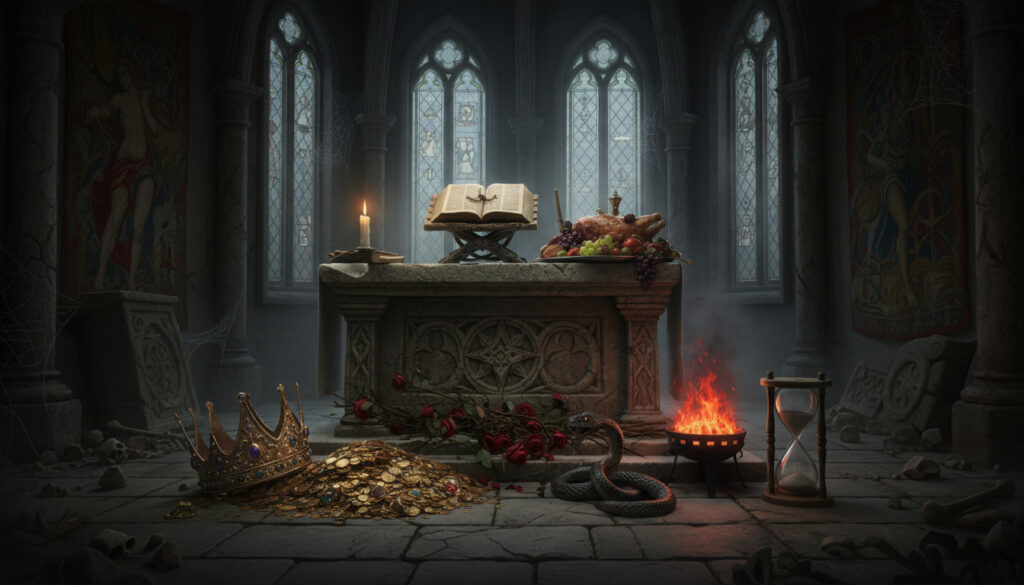
What Are the 7 Deadly Sins in the Bible – List, Verses, Origins
The seven deadly sins represent one of Christianity’s most enduring moral frameworks, yet the specific grouping of pride, greed, lust, wrath, gluttony, envy, and sloth never appears as a unified list within Scripture. Instead, this classification emerged through centuries of monastic tradition, papal refinement, and theological systematization, drawing from scattered biblical references and early desert fathers’ practical counseling tools.
While individual vices such as adultery, theft, and false witness receive explicit condemnation throughout the Old and New Testaments, the precise formulation of seven “capital” or “deadly” sins developed as a pastoral tool rather than a direct biblical extraction. Understanding this distinction requires examining the historical evolution from fourth-century monastic communities to medieval catechisms, alongside the specific verses often associated with each moral failing.
What Are the 7 Deadly Sins?
The Catholic Church formally recognizes seven capital sins that are considered “deadly” not because they guarantee damnation, but because they engender additional spiritual failures. The Catechism of the Catholic Church codifies these in Paragraph 1866 as pride, greed, lust, wrath, gluttony, envy, and sloth.
| Sin | Latin Term | Brief Definition | Opposing Virtue |
|---|---|---|---|
| Pride | Superbia | Inordinate self-esteem; vainglory | Humility |
| Greed | Avaritia | Excessive desire for material wealth | Charity |
| Lust | Luxuria | Intense sexual desire outside divine parameters | Chastity |
| Wrath | Ira | Uncontrolled anger seeking vengeance | Patience |
| Gluttony | Gula | Overindulgence in food and drink | Temperance |
| Envy | Invidia | Sorrow at another’s good fortune | Kindness |
| Sloth | Acedia | Spiritual apathy; avoidance of duty | Diligence |
Key Insights
- The specific grouping of seven never appears verbatim in canonical Scripture
- Proverbs 6:16-19 provides the closest biblical parallel, enumerating seven things the Lord hates
- Fourth-century monk Evagrius Ponticus originally catalogued eight “evil thoughts” rather than seven
- Pope Gregory I consolidated the list around 590 AD, merging vainglory with pride and acedia with sadness
- The Catechism of the Catholic Church formally codifies these as “capital sins” in Paragraph 1866
- Each sin is considered “deadly” because it begets other moral failures
- Gregory paired these with seven opposing virtues: faith, hope, charity, justice, prudence, temperance, and fortitude
Doctrinal Facts
| Sin | Historical Root | Biblical Reference | Classification |
|---|---|---|---|
| Pride | Vainglory merged by Gregory | Proverbs 6:16-17 | Cardinal |
| Greed | Avarice (early monastic) | Luke 12:15 | Capital |
| Lust | Sexual immorality | Matthew 5:28 | Capital |
| Wrath | Anger (Ira) | Matthew 5:22 | Capital |
| Gluttony | Excess (Gula) | Proverbs 23:20-21 | Deadly |
| Envy | Jealousy added by Gregory | Proverbs 14:30 | Capital |
| Sloth | Sadness merged with Acedia | Proverbs 6:9-11 | Cardinal |
Are the 7 Deadly Sins Actually in the Bible?
The seven deadly sins as a unified list do not appear in the Bible as such. While individual transgressions receive extensive treatment throughout Scripture, the specific heptad classification represents ecclesiastical tradition rather than extracted doctrine.
Are the 7 Deadly Sins Catholic or Biblical?
The formulation constitutes Catholic teaching formalized through papal authority and catechism, not biblical canon. The Catholic Church standardized a theological construct developed by Christian monks, whereas biblical texts present moral prohibitions through the Decalogue and various ethical exhortations without grouping them into this specific septet.
The Catechism of the Catholic Church explicitly teaches the seven deadly sins in Paragraph 1866, whereas Protestant traditions generally acknowledge the individual vices without formally adopting the specific heptad classification as definitive doctrine.
Where Does Scripture Mention These Transgressions?
Individual sins appear throughout the Old and New Testaments. Matthew 15:19 enumerates several vices emerging from the heart: “For out of the heart come evil thoughts—murder, adultery, sexual immorality, theft, false testimony, slander.” However, these connections to the Ten Commandments differ from the unified theological framework of the seven deadly sins.
What Bible Verses Relate to the 7 Deadly Sins?
While no single passage presents the complete catalog, discrete verses address components of the framework.
Proverbs 6:16-19 and the Seven Things God Hates
The closest scriptural parallel appears in Proverbs: “There are six things the Lord hates, seven that are detestable to him: haughty eyes, a lying tongue, hands that shed innocent blood, a heart that devises wicked schemes, feet that are quick to rush into evil, a false witness who pours out lies and a person who stirs up conflict in the community.” This enumeration includes a proud look and lying tongue, conceptually overlapping with pride and deceit.
Matthew 15:19 and the Heart’s Evil Thoughts
Matthew 15:19 catalogs vices emanating from the human heart, including adultery and sexual immorality, which align with lust, and theft, which relates to greed. This passage emphasizes internal disposition rather than external action alone.
Luke and the Incomplete References
The Gospel of Luke contains additional references to sinful behaviors, though specific passages remain incomplete in early patristic sources. These texts contributed to the monastic synthesis that eventually produced the standardized list.
What Is the Origin of the 7 Deadly Sins?
The classification system originated not with biblical authors but with early Christian ascetics seeking practical tools for spiritual direction.
Evagrius Ponticus and the Eight Evil Thoughts
The concept originated in the 4th century with Christian monk Evagrius Ponticus, who around 375 AD described eight tempting thoughts or demons: Gluttony, Sexual Immorality (Lust), Avarice (Greed), Sadness (Gloominess), Anger (Wrath), Acedia (Sloth), Vainglory, and Pride. Evagrius developed this list as a practical tool to help spiritual directors counsel struggling individuals in desert monastic communities.
Evagrius developed his original eight evil thoughts as a practical counseling tool for spiritual directors in desert monastic communities, not as abstract theological speculation.
Pope Gregory I and the Refinement to Seven
Pope Gregory I refined this list around 590-600 AD into the form recognized today. Gregory combined sadness (tristitia) with acedia, merged vainglory (vanagloria) with pride (superbia), and added envy to create the standard seven. Gregory was motivated by his theological belief that sin is an innate human trait inherited from Adam and Eve’s fall.
Medieval Systematization
The classification drew on Greco-Roman and Biblical antecedents, later refined by the Desert Fathers and introduced to the Western Church through St. John Cassian. Three Doctors of the Church further refined the theological framework before medieval cultural works disseminated the concept more broadly.
Early development also involved Tertullian in the Christian tradition, though the specific eight-to-seven refinement is definitively attributed to Gregory I’s papal authority.
How Did the 7 Deadly Sins Develop Over Time?
- : Evagrius Ponticus writes of eight evil thoughts in a letter to spiritual directors.
- : Pope Gregory I consolidates the list to seven, establishing the modern standard.
- : Three Doctors of the Church systematize the theology within scholastic tradition.
- : Dante Alighieri’s Divine Comedy vividly depicts the consequences of these sins, granting significant cultural traction.
- : John Wycliffe contributes to codification, influencing Protestant Reformation thought.
What Is Known vs. Uncertain About the 7 Deadly Sins?
| Established Information | Information That Remains Unclear |
|---|---|
| The specific list of seven never appears verbatim in the Bible | Precise biblical chapter-verse mapping for each individual sin classification |
| Catholic Church formalized the teaching in the Catechism (Para. 1866) | Universal acceptance across all Protestant denominations |
| Evagrius Ponticus originated eight thoughts in 375 AD | Whether sadness (tristitia) completely merged into sloth or retains distinct theological status |
| Gregory I consolidated to seven around 590 AD | Exact boundaries between vainglory and pride before Gregory’s merger |
| Individual vices appear throughout Scripture | Whether the “seven” number holds intrinsic theological significance or represents pedagogical convenience |
How Do the 7 Deadly Sins Function in Christian Theology?
The designation “capital” or “deadly” refers to the sins’ capacity to generate additional moral failures, not to unforgivability. Suite Life of Zack and Cody – Cast, Episodes, Cancellation Guide These vices are considered root causes from which other transgressions flow, forming a hierarchical taxonomy of moral disorder. Learn how to perfectly soft boil an egg with this helpful guide: how long to soft boil an egg
Gregory I’s corresponding virtues—faith, hope, charity, justice, prudence, temperance, and fortitude—provide the theological antidote. This framework emphasizes internal heart disposition over external behavioral compliance, aligning with the biblical focus on transformation rather than mere rule-following.
What Did Early Church Authorities Say About These Sins?
“There are six things the Lord hates, seven that are detestable to him: haughty eyes, a lying tongue, hands that shed innocent blood, a heart that devises wicked schemes, feet that are quick to rush into evil, a false witness who pours out lies and a person who stirs up conflict in the community.”
— Proverbs 6:16-19
“For out of the heart come evil thoughts—murder, adultery, sexual immorality, theft, false testimony, slander.”
— Matthew 15:19
Gregory I’s theological motivation centered on the Augustinian concept of original sin as an innate human condition inherited from primordial ancestors, necessitating systematic categorization for pastoral care.
What Should Readers Remember About the 7 Deadly Sins?
The seven deadly sins constitute a pedagogical and pastoral framework developed through early monastic practice and papal refinement rather than direct biblical extraction. While Proverbs 6 and Matthew 15 provide conceptual foundations, the specific grouping of pride, greed, lust, wrath, gluttony, envy, and sloth functions primarily within Catholic moral theology as capital vices requiring the counteractive virtues of faith, hope, and charity. Cast of the Nun 2 – Full Actors List and Roles Guide Individual denominations vary in their formal adoption of this heptad classification, though the underlying moral principles remain widely recognized across Christian traditions.
Is pride the worst of the 7 deadly sins?
Many theologians consider pride the root of all other sins, as it places self above divine authority. Gregory I merged vainglory with pride, elevating its significance as the source from which other vices flow.
What are the 7 virtues that oppose the deadly sins?
Pope Gregory I paired the sins with faith, hope, charity, justice, prudence, temperance, and fortitude. These theological and cardinal virtues serve as spiritual antidotes to the corresponding vices.
Are the 7 deadly sins unforgivable?
No, the designation “deadly” refers to the sins’ capacity to generate further moral failure, not to eternal damnation. Christian doctrine maintains that all sins are forgivable through repentance.
What happened to the eighth sin from Evagrius’s list?
Gregory I merged sadness (tristitia) with acedia (sloth) and combined vainglory with pride, reducing eight to seven. Envy was added as a distinct category to complete the septet.
Do Protestants recognize the 7 deadly sins?
While Protestant traditions acknowledge the individual vices condemned in Scripture, most do not formally adopt the specific heptad classification as definitive doctrine, viewing it as Catholic tradition.
What is the difference between deadly sins and mortal sins?
Deadly sins refer to capital vices that beget other sins, while mortal sins constitute grave matter committed with full knowledge and consent, severing the sinner from grace. All seven deadly sins may become mortal depending on circumstances.
Why did Gregory choose the number seven?
The number seven held symbolic significance in biblical numerology, representing completeness or perfection. This theological numerics likely influenced Gregory’s consolidation from eight to seven categories.
More related posts
 Max Keeble’s Big Move: Plot, Cast, Box Office & Streaming
 What Does Vitamin C Do? Key Benefits, Dosage, and Safety
 Cast of War of the Worlds 2025: Full List and Characters
 File Taxes for Free: IRS, TurboTax & Ireland Guide
 How to Descale Your Keurig: Step-by-Step Guide for All Models
 French Toast Casserole Recipe: How to Fix Common Mistakes
 FC Barcelona vs Real Madrid Lineups – Official 2026 Super Cup XIs
 Wide Leg Jeans Women – Styling Guide 2024