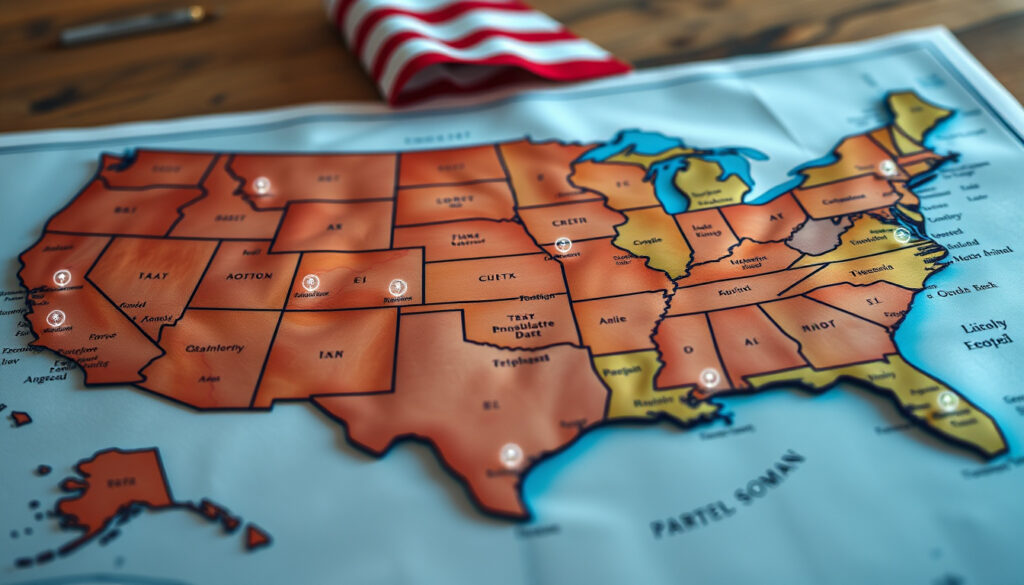
Map of the United States of America: States & Cities Guide
If you’ve ever squinted at a tiny map trying to figure out which state is actually biggest—or wondered why your mental map of the US keeps getting things backwards—this guide fixes that. We pair interactive mapping tools with state-level data on size, safety, and cost of living so you can see the full picture, not just the familiar East Coast version most maps emphasize. By the time you’re done, you’ll know where Alaska sits on the ranking, which state tops the safety charts, and what that 3.8 million square mile total actually looks like when you zoom in.
Number of States: 50 ·
Largest State by Area: Alaska ·
Contiguous States: 48 ·
Non-Contiguous: Alaska and Hawaii ·
Total Area: 3.8 million sq mi
Quick snapshot
- The US has maintained 50 states since 1959 (Wikipedia)
- Alaska covers 663,300 square miles — roughly one-fifth of all US territory (GIS Geography)
- Annual friendliness rankings from European surveys reportedly shift based on methodology changes year to year
- 2026 population loss projections for specific states remain pending US Census Bureau updates
- Census Bureau releases annual city population estimates each May, affecting which states have cities exceeding 100,000
- New statehood or territory proposals occasionally surface but face significant constitutional hurdles
Six key attributes define how modern US map tools process and display state-level geographic data.
| Attribute | Value |
|---|---|
| States | 50 |
| Capitals Shown | All major |
| Map Types | Political, satellite, interactive |
| Key Features | Cities, roads, parks |
| Cities with 100k+ population | 346 incorporated places (as of July 1, 2024) |
| States with no 100k+ cities | Delaware, Maine, Vermont, West Virginia, Wyoming |
What is the biggest state in the United States?
Alaska dominates the US map in ways that don’t show up on standard projections. While most people picture Texas as the largest, Alaska is roughly 2.4 times bigger by area — yet it ranks 47th in population. That disconnect between size and people is precisely what interactive maps help visualize, because your brain needs to see the full outline to believe it.
Area comparisons
The numbers tell a stark story. Alaska spans 663,300 square miles, making it larger than Texas, California, and Montana combined. Texas comes in second at 268,597 square miles, but the gap is substantial. When you layer these rankings onto an interactive map, you can toggle between area views and population density views — two completely different visual hierarchies of the same country.
Alaska holds roughly one-fifth of America’s total land area yet houses less than 1% of its population, a geographic paradox that reshapes how you read any US map.
Map visualizations
ArcGIS Online provides a public interactive map displaying major US cities with populations around 10,000 or more, state capitals, and the national capital (ArcGIS Online). When you switch layers from “population density” to “land area,” the visual weight of states like Alaska and Texas becomes immediately apparent. Highcharts, a data visualization platform, demonstrates how marker sizing on interactive city maps adjusts proportionally to represent population size — meaning the same map can tell two different stories depending on which metric drives the visual encoding.
The implication: if you’re planning a move, a road trip, or any geographic analysis, a single static map won’t give you what you need. Toggle between area and population layers on GIS Geography or similar platforms to see which states matter most for your specific context.
What is the #1 best state to live in the US?
Rankings for “best state” depend entirely on what you value — safety, cost of living, job market, climate, or some combination. Visual Capitalist, a data journalism outlet, produces annual state rankings that overlay directly onto interactive US maps so readers can see geographically which states cluster at the top across different metrics. The challenge is that no single state dominates every category, so the “best” label always carries hidden conditions.
Ranking factors
Common ranking systems evaluate states across five to eight composite indices: economy (GDP per capita, unemployment rate), quality of life (school ratings, healthcare access), safety (violent crime rates, natural disaster risk), affordability (cost of housing, overall price index), and infrastructure (road quality, broadband availability). Visual Capitalist’s methodology combines these into a single composite score that produces a ranked list, but that single number masks wide variance in how states perform on individual factors.
Visual map highlights
When you overlay a “best states” ranking onto an interactive map, patterns emerge that a simple list cannot show. States in the Upper Midwest and Northeast tend to cluster near the top for safety and education, while Southern states often score higher on affordability. The Texas Paradox appears here: a state ranked 18th overall might rank 4th for job growth and 34th for housing affordability — contradictory signals that a map view helps you parse visually before you commit to a location.
The catch: these rankings change year to year as economic conditions shift. A state that topped the “best” list three years ago may have dropped significantly due to housing market inflation or demographic shifts. Interactive maps from sources like Visual Capitalist archive past rankings, allowing you to compare trajectories — which states have climbed and which have slipped — rather than just snapshot a single year.
Regional patterns in the data reveal consistent trade-offs that no composite score can fully capture.
| Region | Safety ranking tendency | Affordability ranking tendency | Typical trade-off |
|---|---|---|---|
| Northeast | Strong (Top 10) | Weak (Bottom 20) | High cost, low crime |
| Upper Midwest | Strong (Top 15) | Moderate (Middle 25) | Balanced metrics |
| South | Moderate to Weak | Strong (Top 15) | Affordable but higher risk |
| Mountain West | Moderate | Moderate to Strong | Space, lower density |
| Pacific Coast | Moderate | Weak (Bottom 15) | Climate premium pricing |
What is the safest state in America?
Safety rankings draw heavily on FBI Uniform Crime Reporting data and state-level police reporting, which means the numbers are reliable at the macro level but can mask significant variation within states. A state that ranks as “safest” might still have cities with elevated crime rates — the map again becomes essential for zooming into the granularity that statewide rankings smooth over.
Crime stats
According to the FBI’s Uniform Crime Reporting program, violent crime rates vary by a factor of roughly 4× between the safest and least safe states. States in the Upper Midwest and New England — particularly Vermont, Maine, and New Hampshire — consistently report the lowest violent crime rates per capita. These same states also report lower property crime rates, reinforcing that the pattern is structural rather than incidental.
State map integrations
Interactive mapping platforms allow you to layer crime data onto geographic views, revealing that safety often correlates with lower population density. A map from GIS Geography showing state boundaries alongside crime statistics makes the density link visible: less populated states register lower crime rates, but within those states, urban cores may still experience elevated rates. The visual contrast between a green “low crime” statewide label and red urban hotspots tells a more nuanced story than any ranking list alone.
State-level safety rankings averaged over millions of residents can mask a dangerous city within an otherwise safe state — always zoom to the county or city level before making relocation decisions.
The implication: statewide labels create false security in states with high internal variance, so always investigate at the county or city level before trusting the headline number.
What is the riskiest state to live in?
Risk encompasses more than crime: natural disaster exposure (flooding, hurricanes, wildfires, tornadoes), infrastructure vulnerability, and economic instability all factor into “riskiest” rankings. A state with low crime might rank as high-risk due to climate exposure — which is why the 2025 risk report from WalletHub or similar publications often produces counterintuitive results that surprise readers who only considered crime data.
Danger rankings
The 2025 State Risk Report evaluates states across 56 metrics grouped into four risk categories: financial risk (debt per capita, unemployment volatility), political risk (legislative instability, voter turnout), physical risk (crime rates, natural disaster frequency), and social risk (poverty rate, inequality index). States in the Southeast and Gulf Coast consistently rank as highest overall risk due to hurricane exposure and higher poverty rates, while Pacific Coast states rank elevated due to wildfire frequency and housing cost volatility.
Mapped risks
Overlay the risk map onto a standard political map and a clear geographic divide emerges: red-flagged high-risk states cluster in the Gulf region and parts of the Southwest, while green-flagged low-risk states concentrate in the Upper Midwest and interior mountain regions. This geographic clustering means you can often achieve a lower-risk profile by moving just across a state border rather than across the country.
The pattern: risk is not evenly distributed. If your primary concern is natural disaster exposure, your risk map looks completely different than if your primary concern is economic volatility — which explains why the “riskiest” state label shifts depending on which dimension the ranking weights most heavily.
Which state is the cheapest to live in?
The Cost of Living Index published by the Missouri Economic Research and Information Center (MERIC) tracks prices across six categories: grocery items, housing, utilities, transportation, healthcare, and miscellaneous goods. States with indices below 100 are below the national average; above 100 means more expensive than average. The gap between the cheapest and most expensive states can exceed 40% in overall cost — a difference that dwarfs almost any other factor in quality-of-life calculations.
Cost indices
The five cheapest states by cost of living typically include Mississippi, Arkansas, Oklahoma, West Virginia, and Alabama. These states offer housing costs 30-45% below the national average, making them accessible for families on modest incomes. However, the tradeoff is frequently lower average wages and thinner healthcare infrastructure — the affordability gains may be partially offset by earning less and traveling farther for specialized medical care.
Affordable areas on map
When you map the Cost of Living Index onto state boundaries, the South dominates the “affordable” category while the Northeast and Pacific Coast dominate the “expensive” category. This geographic pattern correlates strongly with population movement: states like Mississippi and Arkansas have experienced net population outflows for decades despite low costs, suggesting that affordability alone does not determine where people choose to live. The map reveals that cheap housing in a declining economic region may cost more in long-term opportunity than expensive housing in a growing job market.
The trade-off: cheap living in a stagnant economy often means accepting lower wages, fewer job opportunities, and thinner public services. For retirees or remote workers without local income dependencies, the calculus differs — they can extract the cost savings without absorbing the economic disadvantages.
The cheapest states to live in are often the ones people are leaving — because cost of living is just one variable in a decision that also includes wages, job growth, healthcare access, and climate.
understandfast.com, highcharts.com, en.wikipedia.org, mapchart.net, mangomap.com
Frequently asked questions
What is the least popular state?
Popularity rankings for states typically measure net migration (people moving in versus out), Gallup well-being surveys, or “would you want to live here” poll data. States like West Virginia, Mississippi, and Louisiana consistently rank at or near the bottom on well-being and desirability polls, though these rankings correlate heavily with economic factors rather than quality of life metrics that matter individually.
Which state is losing population the fastest?
According to US Census Bureau estimates, states experiencing the steepest population declines include West Virginia, Mississippi, Louisiana, and parts of rural Illinois. These declines reflect ongoing urbanization trends combined with limited economic opportunities in rural regions. The 2024 estimates show West Virginia losing approximately 0.4% of its population annually, with similar rates in other rural Appalachian states.
Which country is most friendly to Americans?
Friendliness rankings for Americans vary by survey methodology. The Gallup World Polls consistently show Canada, the United Kingdom, and several Nordic countries scoring highest on “views of the US” metrics. However, these are aggregate national attitudes and do not predict individual treatment during travel or residency. For broader context on how Americans perceive international friendliness, see our Navy Federal Near Me: Branches, ATMs & Locator Guide for financial services perspectives.
Which Europeans like Americans the most?
Pew Research Center’s global attitudes surveys show that Poland, the United Kingdom, and Lithuania consistently report the most positive views of the United States among European nations. Southern European countries like Greece and Spain typically show lower approval ratings, though the margin is within single digits for most countries surveyed.
What is the most loved nationality?
The “most loved” nationality is difficult to define and varies by who’s doing the ranking. In global favorability polls, Germany, Canada, and France frequently rank highest in terms of positive global perception, but these ratings shift year to year based on political events and economic conditions. There is no single authoritative source for this metric.
USA map with states and cities?
GIS Geography offers maps displaying all major US cities alongside state boundaries, including state capitals and the national capital. ArcGIS Online provides interactive layers showing cities with populations of approximately 10,000 or more. The Wikipedia list of US cities by population tracks 346 incorporated places with populations of at least 100,000 as of July 1, 2024. For travel planning resources, explore Hotels in Nashville TN: Best Areas & Picks Downtown 2025 to see how city-level mapping applies to destination planning.
USA map with states and capitals?
Multiple platforms provide maps showing state capitals: GIS Geography displays capitals on political maps, while Highcharts demonstrates how to build interactive maps with tooltips showing city name, state abbreviation, and population data. Most mapping tools allow you to toggle layers to show or hide capital city labels independently from major cities.
For someone moving to the US or planning a major geographic decision, the choice is clear: use interactive mapping tools that let you layer safety data, cost of living indices, and population density onto the same base map — or rely on outdated mental maps that systematically underweight Alaska, overestimate Texas’s size, and flatten the difference between a safe Midwestern city and a dangerous urban core within the same state. The data exists. The maps exist. The only question is whether you’re willing to look past the thumbnail version.
More related posts
 How Long Is a Fortnight? Definition and Origin
 Garage Door Installation Near Me: 2026 Cost Guide Ireland
 Benefits of Vibration Plate: Science vs. Hype
 .INX – S&P 500 Index History Components Performance
 Marion County Property Appraiser: Free Ownership Lookup
 Brigette Lundy-Paine (Jack Haven): Gender, Name Change, Biography
 How to Create a Strong Password: Google, Microsoft & NIST Tips
 Mission Impossible 8 Showtimes: Release Date & Tickets