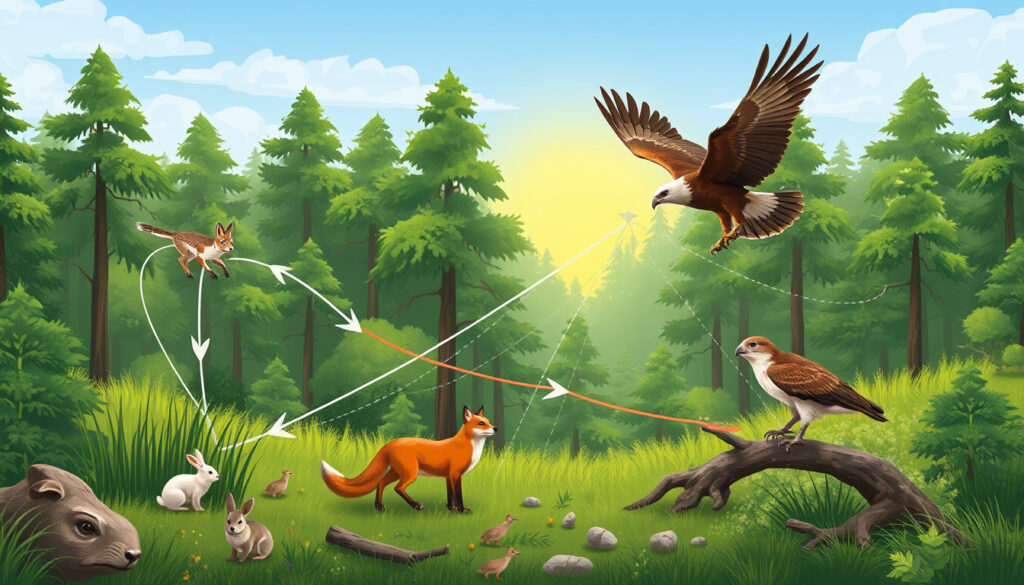
What Is a Food Web? Simple Definition, Examples, and Importance
You’ve probably heard of a food chain—a tidy line from grass to rabbit to fox. But nature rarely works in straight lines. A food web is the messier, truer picture: a tangled network of who eats whom that reveals how energy actually moves through an ecosystem.
Energy transfer efficiency between trophic levels: 10% ·
Common number of trophic levels: 3 to 5 ·
Primary producers in most food webs: Plants and algae
Quick snapshot
- A network of overlapping food chains (Chesapeake Bay Program)
- Shows feeding relationships in an ecosystem (UC Berkeley Museum of Paleontology)
- Includes producers, consumers, and decomposers (Britannica)
- Helps predict ecosystem changes (National Geographic)
- Illustrates energy flow (Wild Earth Lab)
- Shows interdependence of species (National Geographic)
- Grassland: grass → rabbit → fox → eagle (Microbe Notes)
- Ocean: phytoplankton → krill → fish → shark (Microbe Notes)
- Forest: leaves → deer → wolf (Microbe Notes)
- Producers: Autotrophs like plants (Britannica)
- Consumers: Herbivores, carnivores, omnivores (Britannica)
- Decomposers: Bacteria and fungi (Chesapeake Bay Program)
Four key numbers and categories outline the structure of any food web, from a pond to a forest.
| Fact | Detail |
|---|---|
| Definition | A complex network of feeding relationships in an ecosystem |
| Energy Transfer Efficiency | 10% between trophic levels (Chesapeake Bay Program) |
| Number of Trophic Levels | 3 to 5 |
| First Trophic Level | Producers (plants, algae) (Britannica) |
| Producer Base | Underwater grasses and phytoplankton in the Chesapeake Bay (Chesapeake Bay Program) |
| Primary Consumers | Zooplankton, mussels, clams, oysters (Chesapeake Bay Program) |
| Secondary Consumers | Copepods, sea nettles, forage fish like menhaden (Chesapeake Bay Program) |
| Top Predators | Striped bass, bluefish, birds, mammals, and humans (Chesapeake Bay Program) |
What is a simple definition of food web?
A food web is a network of interconnected food chains that shows how energy and nutrients flow through an ecosystem.
Chesapeake Bay Program
Unlike a single food chain that follows one linear path from prey to predator, a food web captures the complex, overlapping feeding relationships among organisms (Chesapeake Bay Program).
Understanding trophic levels
- Trophic levels are positions in the energy flow through an ecosystem, determined by what an organism eats (Chesapeake Bay Program).
- The first and lowest level consists of producers—green plants that convert sunlight into chemical energy (Britannica).
- Herbivores (primary consumers) eat producers; carnivores eat other consumers; omnivores eat both.
Every organism occupies a specific trophic position, and moving up one level costs 90% of the available energy. That harsh arithmetic limits most food webs to just 3–5 levels.
How energy flows through a food web
- Energy enters mostly as sunlight captured by producers (Wild Earth Lab).
- Arrows in food web diagrams point from food source to consumer, showing the direction of energy movement (UC Berkeley Museum of Paleontology).
- Only about 10% of the energy at one trophic level is converted into biomass at the next level; the rest is used for metabolism or lost as heat.
The implication: energy loss limits how many predators an ecosystem can support. A top predator like a shark needs a huge base of producers and prey far below it.
Why is a food web?
Food webs exist because ecosystems are not simple chains—most organisms consume multiple species and are themselves eaten by several predators. Mapping those relationships reveals the hidden structure of an ecosystem.
Role in ecosystem stability
- Food webs allow ecologists to predict how ecosystems will respond to species loss or environmental change (National Geographic).
- A biodiverse web with many connections is more resilient; removing one species may not collapse the whole network.
- Food webs illustrate interdependence—every species relies on others for food, pollination, or decomposition.
Impact of removing a species
- If a top predator disappears, prey populations may explode, overgraze producers, and destabilize the system.
- In the Chesapeake Bay, overfishing striped bass could trigger cascading effects on menhaden and zooplankton (Chesapeake Bay Program).
- Keystone species—ones with disproportionately large effects—are identified through food web analysis.
A food web is only as accurate as the data that fills it. Many species’ diets shift with season and age, making the map a simplification.
What this means: protecting ecosystem health requires knowing the network, not just the players.
What is a food web for kids?
Think of a food web as a map of who eats whom in a neighborhood—except the neighborhood is a forest, ocean, or grassland. Every living thing is connected by what it eats.
Simple food web diagram
- A basic diagram starts with a sun, then arrows to producers (plants), then to primary consumers (plant-eaters), then to secondary consumers (meat-eaters), and finally to decomposers.
- Most diagrams show multiple branches: a rabbit eats grass, a mouse eats seeds, a fox eats both rabbit and mouse.
- Arrows show energy flow, not who is stronger (UC Berkeley Museum of Paleontology).
Examples from everyday life
- In a backyard: lettuce (producer) → caterpillar (primary consumer) → robin (secondary consumer) → hawk (tertiary consumer).
- Decomposers like worms and fungi recycle dead leaves and animals into soil nutrients that plants use.
- Producers are always plants or algae; consumers are animals that eat plants or other animals.
For a hands-on project, try planting a garden and observing which insects visit—that’s your own mini food web. (See also How to Plant Potatoes for a producer you can grow.)
The pattern: the simpler the diagram, the easier it is for kids to grasp that all energy originally comes from the sun.
What is a food web example?
Concrete examples illustrate how food webs differ across ecosystems. Here are three well-studied ones.
Grassland food web
- Producers: grasses, wildflowers.
- Primary consumers: rabbits, grasshoppers, prairie dogs.
- Secondary consumers: foxes, snakes, hawks.
- Tertiary consumers: eagles, wolves.
- Decomposers: bacteria, fungi, dung beetles.
Ocean food web
- Producers: phytoplankton, seaweed.
- Primary consumers: zooplankton, krill, small fish.
- Secondary consumers: herring, squid, jellyfish.
- Tertiary consumers: tuna, sharks, dolphins.
- Deep-sea vents have chemosynthetic producers instead of sunlight (Microbe Notes).
Forest food web
- Producers: trees, shrubs, ferns.
- Primary consumers: deer, squirrels, caterpillars.
- Secondary consumers: owls, raccoons, bears (omnivores).
- Tertiary consumers: wolves, mountain lions.
- Decomposers: mushrooms, bacteria, millipedes.
The trade-off: each example looks different, but the same trophic structure appears—producers at the base, then herbivores, then carnivores, then decomposers closing the loop.
What is a food web in ecosystem?
A food web encompasses all the food chains in an ecosystem, connecting every species through feeding relationships. It is more realistic than a single food chain because most organisms eat and are eaten by multiple species (UC Berkeley Museum of Paleontology).
Components of an ecosystem food web
- Abiotic energy source (sunlight or chemical energy).
- Producers (autotrophs) that create biomass.
- Consumers at multiple trophic levels (herbivores, carnivores, omnivores).
- Decomposers that recycle nutrients back to the soil.
- Detritivores (e.g., earthworms) that eat dead organic matter.
Differences from food chain
- A food chain is a single pathway; a food web is an interconnected network (Wild Earth Lab).
- Food webs include multiple prey and predator options, reflecting real ecosystems.
- Food chains are useful for teaching but oversimplify nature.
Why this matters: when scientists model an ecosystem, they use the food web, not a food chain, because it captures feedback loops and indirect effects that chains miss.
Understanding how energy flows through a food web also highlights the critical importance of biodiversity and ecosystem stability for maintaining ecosystem balance.
Frequently asked questions
How do food webs differ from food chains?
A food chain traces a single path of energy from producer to top predator, while a food web weaves together many food chains to show the actual complexity of an ecosystem’s feeding relationships (Chesapeake Bay Program).
What are producers, consumers, and decomposers?
Producers (plants, algae) make their own food using sunlight. Consumers eat other organisms—herbivores eat producers, carnivores eat consumers, omnivores eat both. Decomposers (bacteria, fungi) break down dead matter into nutrients (Britannica).
Can a food web have more than one top predator?
Yes. Many food webs have multiple top predators that compete for prey or occupy different niches. A forest may host wolves, bears, and mountain lions as apex predators.
Why is the 10% rule important?
The 10% rule means only a small fraction of energy moves to the next trophic level. This limits the length of food chains and the number of top predators an ecosystem can support (Chesapeake Bay Program).
What happens if a species goes extinct in a food web?
Removing a species can cause cascading effects: prey may overpopulate, predators may starve, and the entire web can destabilize. Biodiverse webs are more resilient to such shocks.
How do humans affect food webs?
Human activities—overfishing, deforestation, pollution, and climate change—alter food webs by removing key species, introducing invasive ones, or changing habitats. For example, overfishing menhaden reduces food for striped bass in the Chesapeake Bay.
Food webs are not just classroom diagrams; they are the operating system of every ecosystem. For policymakers and conservationists, the clear implication is that protecting biodiversity means preserving the connections between species, not just the species themselves. For a student or curious reader, the next step is to look at a local habitat—your backyard, a nearby pond, or a park—and try mapping its food web. That small exercise reveals how every living thing depends on another. And for anyone who wants to understand energy transfer on a broader scale, our explanation of Newton’s Laws of Motion Explained shows how the same physical principles apply elsewhere.
More related posts
 Twitter Rate Limit Exceeded: How to Fix It & What It Means
 How to Re et AirPod Pro: Factory Re et Guide (All Model )
 Bane of My Existence: Meaning, Origin, Spelling & Usage
 The Things We Leave Unfinished: Book Overview & Review
 .INX – S&P 500 Index History Components Performance
 Benefits of Vibration Plate: Science vs. Hype
 Pet Grooming Near Me: Costs, Frequency & Breed Guide (Ireland)
 What Is Stockholm Syndrome – Definition, Origins, Real Examples