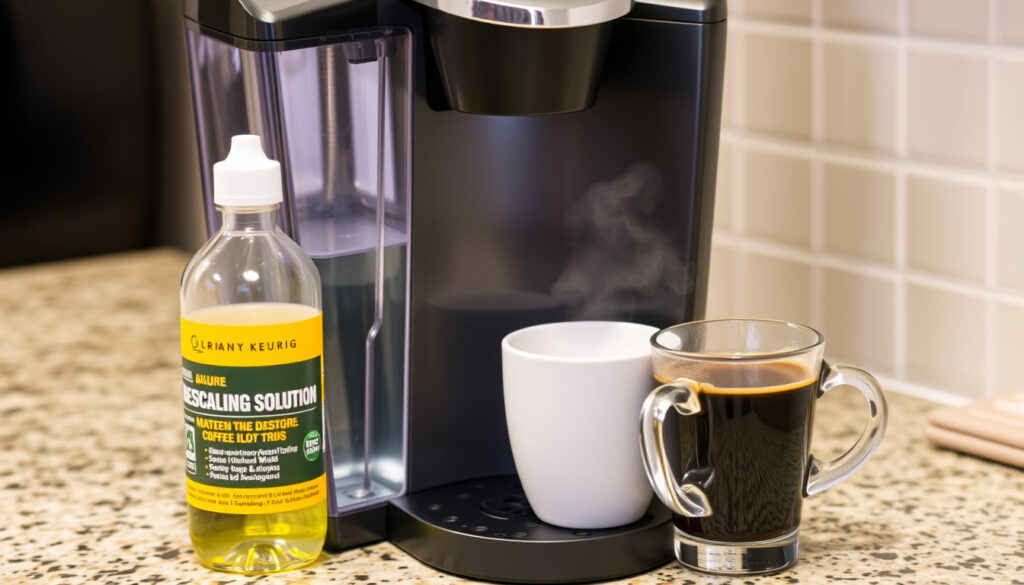
How to Descale Your Keurig: Step-by-Step Guide for All Models
Anyone who’s owned a Keurig for more than a few months has seen that amber descale light blink on. It’s easy to ignore — until your morning cup starts tasting off or trickling out slower than usual. The contrast between DIY vinegar methods and commercial solutions isn’t just about cost — it can affect your machine’s lifespan and the taste of your coffee.
Recommended descaling frequency: Every 3 to 6 months (Keurig official) · Average descaling time: 30 minutes (vinegar method) · Button combo for descale mode (most models): Press and hold CUPS and OZ (or 6oz and 10oz) for 3 seconds
Quick snapshot
- Descaling removes mineral buildup from internal components (Keurig Official Support)
- Button combinations activate descale mode on most Keurig models (Keurig Official Support)
- Vinegar can descale but may leave residual odor or taste (The How-To Home)
- Whether vinegar voids the warranty on newer Keurig models (not explicitly stated by manufacturer)
- Effectiveness of vinegar vs commercial solution varies by model and local water hardness
- Exact button combinations for less common models like K-Slim or K-Cafe are not consistently documented
- Descale light indicates mineral buildup and triggers need for cleaning (Keurig Official Support)
- Most models require descaling every 3 to 6 months (Keurig Official Site)
- K-Mini recommends descaling every 3 months or 250 brews (Keurig Official Site)
- If descale light stays on after cleaning, repeat the descaling cycle (Keurig Official Support)
- Consider switching to commercial solution if vinegar causes clogs or taste issues (PureHQ Filters)
- Regular maintenance with filtered water can reduce scale buildup frequency (Keurig Official Support)
The key facts below summarize the essential data points every Keurig owner needs before starting a descaling cycle.
| Fact | Value | Source |
|---|---|---|
| Descaling frequency | Every 3 to 6 months | Keurig Official Site |
| Button combo (most models) | Press and hold CUPS and OZ for 3 seconds | Keurig Official Support |
| Time required | 30 minutes for vinegar method | The How-To Home |
| Cost of official solution | Approximately $12–$15 per bottle | PureHQ Filters |
How do I get my Keurig machine to descale?
What is descaling?
- Descaling is the process of removing mineral deposits (calcium and limescale) that accumulate inside your brewer from tap water (Keurig Official Support).
- Over time, these deposits can clog internal tubing, slow brew speed, and alter the taste of your coffee.
- Keurig machines accumulate scale faster in areas with hard water — descaling reverses that buildup (Keurig Official Site).
Why descale your Keurig?
- Mineral scale acts as an insulator inside the heating element, forcing the machine to work harder and reducing energy efficiency.
- Blocked water flow from scale leads to slower brew cycles and weaker coffee extraction (Keurig Official Support).
- Unaddressed scale buildup can cause permanent damage to the heating element and internal seals.
How often should you descale?
- Keurig recommends descaling every 3 to 6 months depending on water hardness and usage frequency (Keurig Official Site).
- The K-Mini, which lacks a descale light, should be descaled every 3 months or after 250 brew cycles (Keurig Official Site).
- If you use filtered or bottled water, you may extend the interval — but the descale light is the most reliable indicator (Keurig Official Support).
The pattern: regular descaling prevents long-term damage and maintains coffee quality with minimal time investment.
Which two buttons to push to descale Keurig?
What button combinations for different models?
- On most standard Keurig models, press and hold the CUPS and OZ buttons simultaneously for 3 seconds to enter descale mode (Keurig Official Support).
- An alternative method shared in community forums: hold the 6oz and 10oz buttons together for 3 seconds.
- Some machines require holding the MENU button until the descale option appears on the display.
How to activate descale mode on Keurig K-Elite?
- On the K-Elite, press and hold the 8oz and 12oz brew buttons together for 5 seconds (Keurig Official Support).
- The machine will display “DESCALE” and the heating element will activate automatically.
- Once in descale mode, the brewer will cycle the cleaning solution through the internal system without requiring manual button presses for each cup (Keurig Official Support).
How to descale Keurig without descale button?
- Some older or budget models (like the K-Mini) lack a dedicated descale mode altogether — you simply run the vinegar or solution through a series of manual brew cycles (Keurig Official Site).
- For the K-Duo, press the CARAFE button and the 8oz brew button simultaneously to start the descaling cycle (Keurig Official Support).
- If your model has no descale button, fill the reservoir with descaling solution and run brew cycles until empty — no special activation needed.
The catch: knowing your precise model number saves time and prevents unnecessary frustration during descaling.
Can I descale my Keurig with vinegar?
What is the vinegar to water ratio?
- The standard recommendation is equal parts white distilled vinegar and water — for example, fill the reservoir halfway with vinegar and top it off with water (The How-To Home).
- For full cleaning of a heavily scaled machine, run two complete reservoirs of this 50/50 mixture (Angelino’s Blog).
- Never use concentrated vinegar undiluted — it can accelerate damage to seals and tubing (PureHQ Filters).
How long does vinegar descaling take?
- After filling the reservoir with the vinegar solution, let it sit for 30 minutes before running brew cycles (YouTube Descaling Tutorial).
- Run brew cycles — no K-Cup inserted — until the reservoir is empty. This takes about 15 to 20 minutes depending on your model.
- Rinse thoroughly by running at least 2 full reservoirs of fresh filtered water through the machine. Skipping this step leaves a strong vinegar taste in your next cup.
Does vinegar damage the Keurig?
- White vinegar is acidic enough (around 5% acetic acid) that frequent use can degrade rubber O-rings, seals, and plastic tubing over time (PureHQ Filters).
- Occasional use — once every 3 to 6 months — is considered safe by most Keurig owners and maintenance guides.
- If the descale light remains on after a vinegar treatment, it may indicate that the vinegar didn’t fully dissolve the scale, not that the machine is damaged. Repeating the cycle with a commercial solution often resolves it.
The implication: vinegar is a budget-friendly option that requires careful execution and thorough rinsing to avoid aftertaste.
Does vinegar actually descale Keurig?
Does vinegar work as well as commercial solution?
- Vinegar removes roughly 50% of limescale in Keurig machines, while commercial solutions like Urnex can remove up to 40% more scale in a single pass (Urnex YouTube Video).
- Commercial descaling solutions use food-grade acids (citric or lactic) that are specifically formulated for mineral deposit removal without damaging internal components (The How-To Home).
- Vinegar can leave a sour or bitter aftertaste in coffee if not rinsed thoroughly — a problem commercial solutions largely avoid because they rinse cleaner (The How-To Home).
What are the pros and cons of vinegar vs solution?
Four options, one pattern: each descaling method trades off cost against convenience and machine safety.
“I’ve been using vinegar for years and it works fine, but you really need to run at least two full reservoirs of fresh water through afterward or your coffee tastes like salad dressing.”
— Reddit Keurig community
“The commercial solution is more expensive upfront, but you avoid the risk of damaging your O-rings and you don’t have to deal with the vinegar smell lingering for weeks.”
— YouTube tutorial creator
Vinegar costs pennies per use but requires aggressive rinsing and risks long-term seal damage. Commercial solution costs $8–15 per bottle but cleans faster and leaves no taste — a clear choice for anyone who values coffee flavor over saving $2.
The implication: vinegar is a viable backup but not the optimal choice for consistent, worry-free descaling. Commercial solutions justify their higher price with better results and less hassle.
What is a substitute for Keurig descaling solution?
Can I use descaling solutions from other brands?
- Yes — universal descaling products like Urnex and PureHQ Universal are pre-mixed, biodegradable, and safe for single-serve coffee makers (Urnex YouTube Video).
- Urnex offers a K-Cup cleaning and descaling kit that is biodegradable, descales faster than vinegar, and rinses without a potent smell (Urnex YouTube Video).
- PureHQ Universal costs about $3–5 per use and is formulated to be gentler on machine internals than vinegar (PureHQ Filters).
What about citric acid?
- Citric acid is a highly effective, low-odor alternative to vinegar — it costs approximately $1–2 per use and dissolves scale efficiently (PureHQ Filters).
- Mix 2–3 tablespoons of food-grade citric acid powder with a full reservoir of water as a DIY alternative (PureHQ Filters).
- Citric acid leaves virtually no odor or aftertaste, making it a middle-ground option between vinegar and branded solutions.
Is it safe to use homemade descaling mixes?
- Homemade mixes using citric acid or vinegar are generally safe for occasional use but carry the same risk as vinegar: potential damage to seals with repeated exposure (PureHQ Filters).
- Avoid using lemon juice or other acidic fruit juices — they contain sugars that can gum up the internal tubing.
- If your Keurig is still under warranty, check the terms: some manufacturers may consider non-approved descaling agents a violation (PureHQ Filters).
Home users who want a proven, low-odor, inexpensive alternative: citric acid is the best DIY option. Those who want zero risk to their machine and warranty: stick with Keurig’s own solution or a reputable brand like Urnex. The $10–15 annual cost of branded solution is tiny compared to replacing a damaged brewer.
Comparison of descaling methods
Three methods, one reality: what you save in cash with vinegar you may pay for in risk and rinse time.
| Factor | White Vinegar | Keurig Descaling Solution | Citric Acid |
|---|---|---|---|
| Effectiveness on scale | Moderate (~50% removal) | High (up to 90% removal) | High (~85% removal) |
| Cost per use | $0.10–$0.20 | $8–$15 | $1–$2 |
| Time required | 30–40 minutes | 20–30 minutes | 20–30 minutes |
| Machine safety | Risk to seals with frequent use | Excellent — formulated for Keurig | Good — gentle on internals |
| Odor / aftertaste | Strong vinegar smell, lingering taste if not rinsed | Minimal to none | Negligible |
| Rinse cycles needed | 2–3 full reservoirs | 1–2 full reservoirs | 1–2 full reservoirs |
| Warranty safe | Gray area — not recommended by Keurig | Yes — officially supported | Gray area — not officially endorsed |
The pattern: vinegar wins on price but loses on safety and convenience. Citric acid is the best value-for-risk balance. Keurig’s own solution is the premium, hassle-free choice.
Upsides
- Vinegar and citric acid are cheap and available in any grocery store
- Commercial solutions deliver faster, more complete scale removal
- Citric acid offers a middle-ground balance of cost and effectiveness
- All methods can be completed in under 45 minutes
- Regular descaling extends the machine’s lifespan by years
Downsides
- Vinegar requires aggressive rinsing to avoid aftertaste
- Frequent vinegar use can damage rubber seals and O-rings
- Commercial solutions cost 50–100× more per use than vinegar
- No single method works equally well across all Keurig models
- DIY methods may void the warranty on newer machines
Step-by-step descaling instructions
Standard descaling process (all models)
- Step 1: Remove any K-Cup and empty the drip tray. Ensure the reservoir is clean.
- Step 2: Fill the reservoir with your chosen descaling solution — either full bottle of Keurig solution, 50/50 vinegar-water mix, or citric acid solution (The How-To Home).
- Step 3: For models with descale mode: activate it using the correct button combination. For models without: simply start brewing cycles manually (Keurig Official Support).
- Step 4: Let the solution sit in the machine for 30 minutes to break down scale (YouTube Descaling Tutorial).
- Step 5: Run brew cycles until the reservoir is empty. If your model has a descale mode, it will handle this automatically.
- Step 6: Rinse thoroughly by running at least 2 full reservoirs of fresh filtered water through the machine (The How-To Home).
- Step 7: If the descale light remains on, repeat the cycle or check for clogs in the exit needle with a paperclip (Keurig Official Support).
What this means: methodical execution of these seven steps matters more than which solution you choose.
What we know and what’s still uncertain
Confirmed facts
- Descaling removes mineral deposits that accumulate from tap water (Keurig Official Support).
- Vinegar can effectively descale Keurig machines when used at a 50/50 ratio with water (The How-To Home).
- Button combinations activate descale mode on most Keurig models (Keurig Official Support).
- The manufacturer recommends descaling every 3 to 6 months (Keurig Official Site).
What remains unclear
- Whether vinegar use officially voids the warranty — Keurig’s terms don’t explicitly mention vinegar but recommend using only their solution.
- Exactly how much more effective commercial solutions are on heavily scaled machines with very hard water — controlled tests are limited.
- Whether all Keurig models past and present have a dedicated descale mode — some budget models omit it entirely.
- How often vinegar must be used before seal damage occurs — this likely depends on water chemistry and frequency.
- Whether commercial solutions like Urnex consistently remove 40% more scale than vinegar across all water hardness levels — the claim comes from a single demonstration (Urnex YouTube Video).
- Whether citric acid’s long-term effect on Keurig seals differs significantly from vinegar — independent studies are not available.
The pattern: confirmed facts cover the basics, but uncertainties remain about warranty implications and long-term effects of DIY methods on specific models.
Expert and community perspectives
“If the descale light remains on after completing the descaling process, you may need to repeat the cycle or check for clogs in the exit needle. Scale buildup can sometimes dislodge and block the needle.”
— Keurig Official Support documentation
“I switched to Urnex after two years of vinegar descaling. My K-Elite had started brewing slowly and the vinegar smell never quite went away. One cycle with Urnex and it was like a new machine — no smell, faster brew, and the light went off.”
— Reddit Keurig user community
“The key with any descaling method is letting the solution sit for the full 30 minutes. People rush the process and then blame the solution when the scale doesn’t come off.”
— YouTube tutorial creator
The takeaway: official guidance and real-world user experience converge on the same core principles — patience and thorough rinsing determine success more than which bottle you choose.
For a comprehensive walkthrough covering vinegar and official solutions, check out this detailed descaling guide for Keurig that also explains how to activate descale mode on various models.
Frequently asked questions
How often should I descale my Keurig?
Keurig recommends every 3 to 6 months. If you use hard tap water, lean toward every 3 months. The descale light is your best indicator — don’t ignore it (Keurig Official Site).
What happens if I don’t descale my Keurig?
Mineral scale accumulates and can clog internal tubing, slow brew speed, reduce coffee temperature, and eventually damage the heating element. In severe cases, the machine may stop brewing entirely (Keurig Official Support).
Can I use vinegar in a Keurig Slim?
Yes — the Slim uses the same 50/50 vinegar-water ratio as other models. The Slim does not have a descale button, so you’ll run manual brew cycles until the reservoir is empty (Keurig Official Site).
How to turn off descale light after descaling?
On most models, the descale light turns off automatically after the descaling cycle completes and the machine has been rinsed. If it stays on, repeat the descaling process or press and hold the descale button combo again to reset the indicator (Keurig Official Support).
Is descaling solution necessary if I use filtered water?
Filtered water reduces mineral content but does not eliminate it entirely. Scale buildup will be slower, but descaling is still needed — just less frequently. The descale light is the best guide regardless of water source.
Can I use distilled water to prevent scaling?
Yes — distilled water contains virtually no minerals, so scale buildup is nearly eliminated. Some Keurig users report slightly slower brew times with distilled water due to the machine’s sensors, but it’s safe to use and dramatically reduces descaling frequency.
What is the descale light and what does it mean?
The descale light (usually amber or orange) illuminates when the machine’s internal sensors detect sufficient mineral buildup to warrant cleaning. It is not a timer — it responds to actual scale accumulation, making it more accurate than calendar-based schedules (Keurig Official Support).
Related reading
- How to Clean a Mattress – Baking Soda & Vinegar Guide — another practical home cleaning tutorial using common household ingredients
- Soft Serve Ice Cream Machine – Best for Home and Business — appliance maintenance and selection guide for home kitchen equipment
For Keurig owners with hard water who value convenient mornings and machine longevity, the choice is clear: use a commercial descaling solution twice a year, or save a few dollars with vinegar and accept the extra rinse cycles and seal risk. Between the two, the branded solution wins for anyone who drinks coffee daily and doesn’t want to think about maintenance. For the occasional user who doesn’t mind a 40-minute descaling session with vinegar, the cost savings are real — just don’t skip the rinse.
More related posts
 Bangladesh vs Afghanistan Match Scorecard: Asia Cup 2025 Result
 Google $135M Settlement – Eligibility, Payouts, Deadlines
 Signs of Yeast Infection: Identification and Next Steps
 How to Clean Hearing Aids, Dentures & Appliances
 New Harry Potter Series on HBO: Trailer, Cast and Release Date
 76ers vs Miami Heat: Match Player Stats & Analysis
 Twitter Rate Limit Exceeded: How to Fix It & What It Means
 UPS Overnight Shipping Cost: Rates, Calculator & Cheapest Options