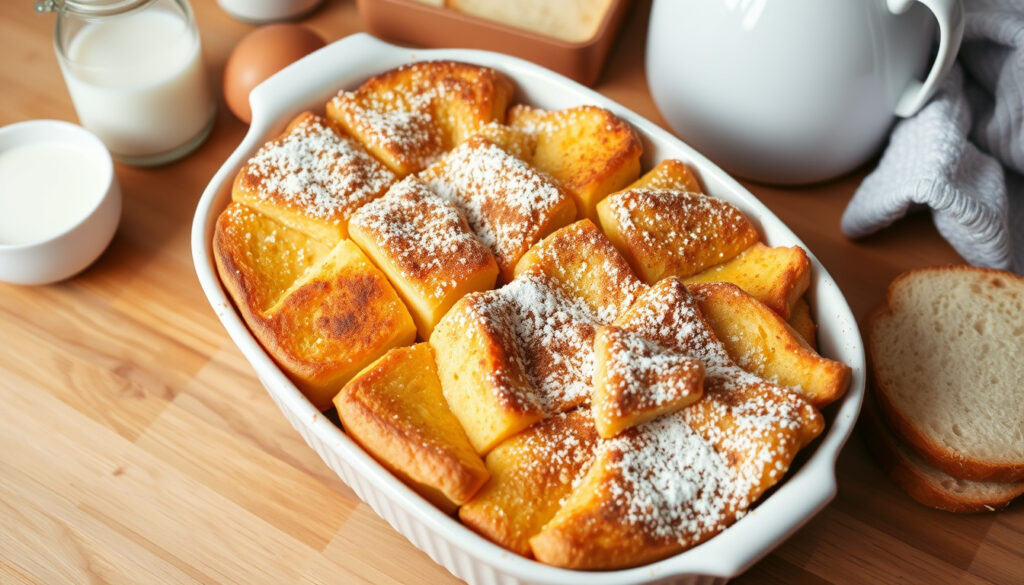
French Toast Casserole Recipe: How to Fix Common Mistakes
Few breakfast dishes feel as effortlessly impressive as a French toast casserole — until the first bite reveals a soggy middle or a dry, custard-less center. The difference between a showstopper and a disappointment often comes down to a handful of simple choices: the bread you pick, how long you let it soak, and the ratio of eggs to milk.
Prep time: 15 minutes ·
Soak time: At least 30 minutes or overnight ·
Bake time: 45–60 minutes ·
Ideal bread: Stale, thick-cut bread like brioche or challah ·
Key ratio: 6 eggs to 2 cups milk for standard 9×13 dish
Quick snapshot
- Stale bread reduces sogginess (Belle of the Kitchen)
- Overnight soak improves texture (A Spicy Perspective)
- Baking uncovered last 10 minutes crisps top (Tastes Better From Scratch)
- Effect of different milk fat percentages on texture is not well documented (Gift of Hospitality)
- Optimal soak time for gluten-free breads is uncertain (Gift of Hospitality)
- Overnight refrigeration allows bread to fully absorb custard for best texture (A Spicy Perspective)
- Quick 30-minute soak works if bread is stale (Belle of the Kitchen)
- Try topping with streusel for extra crunch (Tastes Better From Scratch)
- Serve with maple syrup, fresh fruit, or whipped cream (Tastes Better From Scratch)
Five key numbers tell the story of a well-executed French toast casserole. Here’s what they reveal about timing, ratios, and yield.
| Spec | Value |
|---|---|
| Total time | 1 hour 15 minutes to overnight + bake time |
| Servings | 8–10 |
| Custard ratio | 6 eggs : 2 cups milk |
| Optimal bake temp | 350°F (175°C) |
| Bread volume | About 1 pound or half a loaf |
The implication: these specs form a baseline that home cooks can adjust without risking failure.
What Are Common Mistakes When Making French Toast Casserole?
Using the wrong bread type
Fresh, soft bread soaks up liquid too fast and turns into mush. Belle of the Kitchen recipe developer stresses that day-old or stale bread is essential because it absorbs custard without disintegrating. Crusty breads like French loaf, sourdough, or brioche hold their shape and give you that fluffy interior.
Skipping the soak time
Rushing the soak leads to dry pockets and uneven custard distribution. A Spicy Perspective food blog notes that overnight refrigeration lets the egg mixture fully penetrate every cube, creating a creamy, custard-like center. Even 30 minutes of soak time makes a difference — but only if your bread is already stale.
Overloading with liquid
Too much milk or cream guarantees a wet, heavy casserole. The standard ratio — 6 eggs to 2 cups of milk — works for a 9×13 dish, but if you use soft bread, Belle of the Kitchen recommends reducing the liquid slightly. A common culprit is adding extra milk “just in case.”
Baking at too high a temperature
High heat sets the eggs too quickly, leaving the inside undercooked and the top scorched. Tastes Better From Scratch recipe site bakes at 350°F for 40–50 minutes until golden. For a crispier top, they suggest uncovering the dish for the last 10 minutes.
Most soggy casseroles trace back to one variable: the bread’s absorbency vs. the liquid volume. Using stale bread and a disciplined custard ratio eliminates the guesswork.
What Are the Ingredients in French Toast Casserole?
Egg custard base
Eight large eggs are the standard for a full casserole, according to A Spicy Perspective. They provide structure and richness. The eggs should be whisked until smooth but not frothy — over-beating can create air pockets that lead to uneven baking.
Milk and cream options
Whole milk is the most common base, but half-and-half — used by A Spicy Perspective at 3.5 cups — delivers a noticeably richer texture. Gift of Hospitality uses 3 cups of milk as an alternative. Skim or 2% milk will work but produce a less creamy result.
Sweeteners and spices
Brown sugar is the preferred sweetener for caramelized depth; white sugar is a neutral substitute. Cinnamon and nutmeg are almost universal, and Chew Out Loud food blog recommends a dash of almond extract as an optional flavor booster.
Butter and brown sugar topping
Many recipes, including Gift of Hospitality, dot butter and sprinkle cinnamon sugar over the top before baking. Tastes Better From Scratch kicks it up with a streusel of brown sugar, white sugar, cinnamon, nutmeg, and cold butter — this creates a crisp, crackly crust.
Every ingredient choice — from milk fat to sugar type — shifts the casserole’s texture and sweetness. A home cook aiming for a fluffy result should prioritise whole milk or half-and-half and brown sugar, while a crisp-top lover should invest in the streusel.
What’s the Best Bread for French Toast Casserole?
Stale, thick-cut breads (brioche, challah, French loaf)
The Pioneer Woman recipe hub calls crusty sourdough or French bread the top choices because they balance absorbency and structure. Brioche and challah add richness and a slight sweetness. Belle of the Kitchen recommends cutting the loaf into 1-inch cubes and drying them on a cookie sheet overnight for 12 hours to maximise absorption without sogginess.
Can you use regular sliced bread?
Yes — but with caution. Sandwich bread is softer and more porous. Belle of the Kitchen warns that it may turn mushy if not properly dried. If you use sliced bread, toast it lightly or leave it out overnight to stale it first.
Bread size and crust considerations
Cutting bread into 1-inch cubes ensures each piece soaks evenly, as recommended by Tastes Better From Scratch. Keeping the crust on adds chewiness and helps the cubes hold their shape. A 1-pound loaf yields about 10 cups of cubes — enough for a standard 9×13 dish.
The pattern: Dense, crusty breads reward patience with a sturdy structure that resists mushiness. Soft breads demand extra drying steps to perform.
Does French Toast Casserole Have to Soak Overnight?
Minimum soak time
For stale, dense bread, 30 minutes is the floor — anything less leaves the interior dry. Belle of the Kitchen confirms that a quick soak works if the bread is already dry and crusty.
Benefits of overnight soaking
Overnight refrigeration (8–12 hours) allows the custard to migrate deep into every bread cube. A Spicy Perspective describes the result as a “fluffy custard-like interior with a crispy top” that can only be achieved with extended soak time. The difference is especially noticeable with softer breads like brioche.
Quick-soak alternatives
If you’re short on time, dry the bread cubes in a 300°F oven for 10 minutes before adding custard. This mimics the effect of stale bread and allows a 30-minute soak to still deliver decent texture. Lil’ Luna recipe site suggests baking for 45–60 minutes depending on how soft you want the center.
Overnight soaking demands planning but delivers the most reliable texture. Quick methods are fine for weekday mornings but increase the risk of a dry or uneven bake — especially if you skip the pre-drying step.
How to Prevent Soggy French Toast Casserole?
Control liquid ratio
Stick to the 6 eggs to 2 cups milk baseline for a standard 9×13 dish. Belle of the Kitchen advises reducing milk slightly if you’re using soft bread. Measure your liquid by volume, not by eye — an extra half cup can make the difference between fluffy and soggy.
Use stale or toasted bread
Day-old bread that is slightly dry absorbs custard without falling apart. Belle of the Kitchen suggests drying bread cubes on a cookie sheet overnight to enhance absorption. If you can’t wait, toast the cubes in a 300°F oven for 10 minutes.
Avoid over-soaking
Even stale bread can become waterlogged if left in liquid for too long. Tastes Better From Scratch recommends draining any excess custard that hasn’t been absorbed after 15 minutes of soaking — especially for quick-soak methods.
Bake uncovered for last part of cooking
Covering the casserole traps steam, which softens the top. Tastes Better From Scratch bakes uncovered for the full time to let moisture escape. If you prefer a softer top, cover with foil for the first 30 minutes, then uncover for the last 10–15 to crisp the top.
What this means: Sogginess is a function of too much liquid trapped in bread that cannot hold its structure. Controlling the bread’s dryness and the custard volume fixes the problem at its source.
Step-by-Step Instructions: How to Make French Toast Casserole
Follow these steps for a consistent, fluffy result. Each stage draws from tested recipes across multiple sources.
- Prep the bread: Cut a 1-pound loaf of stale French bread, brioche, or challah into 1-inch cubes. Spread on a baking sheet and leave uncovered overnight to dry, or bake at 300°F for 10 minutes (Belle of the Kitchen).
- Make the custard: Whisk together 8 large eggs, 2 cups whole milk (or 3.5 cups half-and-half), ¼ cup brown sugar, 1 teaspoon vanilla extract, 1 teaspoon cinnamon, and ¼ teaspoon nutmeg (A Spicy Perspective).
- Assemble: Place the dried bread cubes in a greased 9×13 baking dish. Pour the custard evenly over the bread, pressing down gently to submerge all pieces. Cover and refrigerate at least 30 minutes, preferably overnight (Tastes Better From Scratch).
- Add topping: Before baking, mix ½ cup brown sugar, ½ cup white sugar, 1 teaspoon cinnamon, ½ teaspoon nutmeg, and ½ cup cold butter into a crumbly streusel. Sprinkle over the casserole (Tastes Better From Scratch).
- Bake: Preheat oven to 350°F. Bake uncovered for 45–60 minutes, until golden and set in the center. Let cool for 10 minutes before serving (Tastes Better From Scratch).
- Serve: Dust with powdered sugar and serve with maple syrup, fresh berries, or whipped cream.
Confirmed Facts vs. What’s Still Unclear
Confirmed facts
- Stale bread prevents sogginess (Belle of the Kitchen)
- Overnight soak improves texture (A Spicy Perspective)
- Baking uncovered last 10 minutes crisps top (Tastes Better From Scratch)
- Excess liquid causes mushiness (Belle of the Kitchen)
What’s unclear
- Effect of different milk fat percentages on texture is not systematically studied
- Optimal soak time for gluten-free breads is unknown
- Whether pre-toasting bread cubes is better than oven-drying for quick soaks is debated (Lil’ Luna)
- Best reheating method for maintaining crispness is not established
What the Experts Say
“The most important thing is to use day-old bread that is slightly dry — it absorbs the custard without falling apart.”
Belle of the Kitchen
“Overnight refrigeration allows the bread to fully soak in the egg-milk mixture, creating a fluffy custard-like interior with a crispy top.”
A Spicy Perspective
“Bake uncovered for 45–60 minutes, and let cool 10 minutes before serving — this helps the structure set.”
Tastes Better From Scratch
The pattern across all three experts is that preparation matters more than the baking itself. The investment in stale bread, proper soak time, and correct liquid ratio is what separates a top-tier casserole from a disappointing one.
Summary
For anyone who has been burned by a soggy breakfast bake, the fix isn’t a secret ingredient — it’s a disciplined approach to bread, custard, and time. Use day-old bread, stick to the 6:2 egg-to-milk ratio, and give the casserole at least a half-hour to soak, preferably overnight. The home cook who wants reliability without fuss must commit to planning ahead, or accept the risk of a wet middle.
Frequently asked questions
Can I use gluten-free bread for French toast casserole?
Yes, but results vary. Gluten-free breads are often softer and more absorbent. Belle of the Kitchen recommends toasting the cubes until dry and using slightly less custard to avoid mushiness.
How do I store leftover French toast casserole?
Cover with foil or transfer to an airtight container and refrigerate for up to 3 days. Reheat individual portions in a toaster oven or in a 350°F oven for 10 minutes to restore some crispness, as suggested by Tastes Better From Scratch.
Can I make French toast casserole without eggs?
Eggs are central to the custard’s structure. Commercial egg replacers or a mixture of flaxseed meal and water can work, but the texture will be denser and less fluffy. For best results, use a recipe specifically designed for egg-free French toast.
What is the best pan size for French toast casserole?
A standard 9×13-inch baking dish is the most common. A 9×9-inch dish will work for smaller batches but requires reducing the custard proportionally to avoid overflow. A Spicy Perspective uses a 9×13 for a 1-pound loaf.
Can I add fruit or nuts to French toast casserole?
Absolutely. Blueberries, sliced bananas, or chopped pecans can be layered with the bread cubes before adding custard.
How do I know when the casserole is fully baked?
The center should be set and not jiggle when you shake the dish. A knife inserted into the center should come out clean. Tastes Better From Scratch recommends baking 45–60 minutes and then letting it rest 10 minutes before serving.
Can I double the recipe for a larger crowd?
Yes. Double all ingredients and use a 12×18-inch half-sheet pan or two 9×13 dishes. Bake time may increase by 10–15 minutes because of the larger volume. Check for doneness with the knife test.
Related reading: Tini Mac and Cheese Recipe · White Bean Chicken Chili
More related posts
 Hotels in Myrtle Beach, SC: Where to Stay & Areas to Skip
 Mission Impossible 8 Showtimes: Release Date & Tickets
 Bane of My Existence: Meaning, Origin, Spelling & Usage
 Best iPhone 16 Pro Case 2026: Drop-Proof & Worth It
 Toronto Raptors vs Golden State Warriors Player Stats (Jan 2026)
 2025 Standard Deduction Married Filing Jointly: $31,500
 28 Weeks Later Cast – Actors, Characters and Key Insights
 The Thursday Murder Club on Netflix: Movie or Series