Cookies and Cream Ice Cream: Origin, Recipe, Health
Few ice cream flavors feel as universally loved as cookies and cream. But behind that familiar crunch of chocolate sandwich cookie in vanilla lies a surprisingly contested history — one that involves a university dairy plant, at least four people claiming credit, and a former president’s boycott.
Year of invention: 1979 ·
Inventor: Joe Leedom ·
Institution: South Dakota State University ·
Base flavor: Vanilla ·
Typical cookie used: Chocolate sandwich cookie (Oreo)
Quick snapshot
- Cookies and cream ice cream is typically vanilla ice cream mixed with chocolate sandwich cookie pieces (Wikipedia (user-contributed encyclopedia)).
- The flavor was invented in 1979 at South Dakota State University (Dairy Herd Management (dairy industry publication)).
- Blue Bell Creameries was the first to mass-produce it commercially in 1980 (Wikipedia).
- It became one of the top five best-selling ice cream flavors by 1983 (Wikipedia).
- Exact date when Oreo became the default cookie for commercial brands (Wikipedia).
- Precise nutritional differences between store-bought and homemade versions (Tasting Table (food culture outlet)).
- Who truly invented it — at least four parties claim credit (Tasting Table).
- Why no patent or license was filed to protect the SDSU invention (Tasting Table).
- 1912 – Oreo cookie introduced (Wikipedia).
- 1979 – SDSU invention (Dairy Herd Management).
- 1980s – Mass production begins (Wikipedia).
- 2019 – Trump Oreo boycott (Wikipedia (Oreo article)).
- Continued demand for homemade and craft versions (Wikipedia).
- More brands offering dairy-free and low-sugar alternatives (Tasting Table).
- Oreo boycott impact likely faded, but cookie brand remains central (Wikipedia).
Six key facts, one pattern: the invention story is more tangled than most dessert lore admits.
| Invented | 1979 |
| Inventor | Joe Leedom |
| Institution | South Dakota State University |
| First commercial maker | Blue Bell Creameries |
| Base flavor | Vanilla |
| Cookie type | Chocolate sandwich (Oreo or similar) |
What is cookies and cream ice cream?
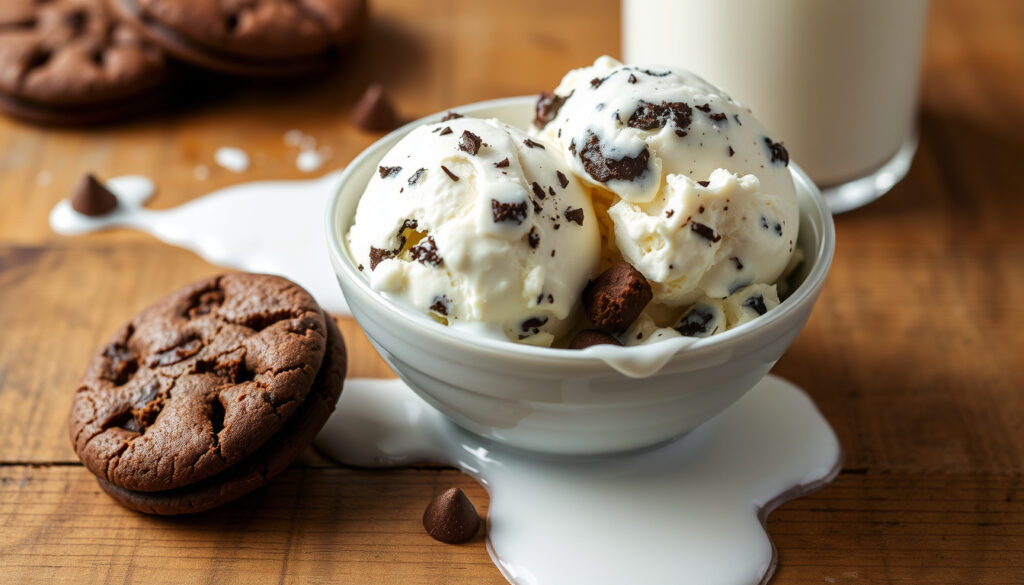
Cookies and cream is a variety of ice cream made by mixing crumbled chocolate sandwich cookies into vanilla ice cream; variations may use chocolate, coffee, or mint ice cream (Wikipedia (user-contributed encyclopedia)). Also known as cookies ‘n cream, cookies ‘n creme, or cookie cream (Wikipedia). The most popular version uses Oreo cookies under a licensing agreement or similar cookies from other brands (Wikipedia).
What kind of ice cream is in cookies and cream?
- The base is almost always vanilla ice cream (Wikipedia).
- Some premium brands use a custard-style base with egg yolks (Tasting Table (food culture outlet)).
- No-churn versions use whipped cream and sweetened condensed milk as a shortcut (Wikipedia).
Is cookies and cream just Oreo flavor?
- Although commonly associated with Oreo, the flavor predates exclusive Oreo use and can be made with any chocolate sandwich cookie (Wikipedia).
- Many store brands use generic chocolate sandwich cookies to avoid licensing fees (Tasting Table).
- The term “cookies and cream” is not trademarked (Wikipedia).
What type of cookies are used in cookies and cream ice cream?
- Most commonly, chocolate sandwich cookies with a white cream filling, such as Oreo (Wikipedia).
- Some artisanal versions use double-stuffed or dark chocolate cookies (Tasting Table).
- Gluten-free cookies can substitute for those with dietary restrictions (Wikipedia).
Where did cookies and cream ice cream come from?
What country is cookies and cream ice cream from?
- The flavor was invented in the United States at South Dakota State University’s dairy plant (Dairy Herd Management (dairy industry publication)).
- Commercial production began in the U.S. in the 1980s (Wikipedia).
Who made the original cookies and cream ice cream?
- The invention is credited to dairy science student Joe Leedom under the supervision of plant manager Shirley Seas at SDSU in 1979 (Wikipedia (user-contributed encyclopedia)).
- However, at least three other claimants exist: ice cream consultant Malcolm Stogo (1976–78), Blue Bell Creameries (which mass-produced in 1980), and Dreyer’s/Edy’s official taster John Harrison (1982) (Tasting Table (food culture outlet)).
- The lack of a patent or license filed by SDSU allowed the dispute to persist (Tasting Table).
Four parties claim to have invented cookies and cream. But the strongest evidence — a university dairy record from 1979 — points to SDSU. The lack of a patent means the story may never be definitively settled.
The implication: even a simple mix of cookie and cream can spark a decades-long debate over who gets the credit.
How do you make cookies and cream ice cream?
What are the main ingredients in cookies and cream ice cream?
- Whole milk, heavy cream, sugar, vanilla extract, and chocolate sandwich cookies (Wikipedia).
- No-churn versions use whipped cream and sweetened condensed milk (Wikipedia).
- Optional: a pinch of salt to balance sweetness (Tasting Table (food culture outlet)).
Here is a simple homemade recipe adapted from SDSU’s original approach:
- In a medium bowl, whisk together 2 cups heavy cream, 1 cup whole milk, and ¾ cup sugar until sugar dissolves.
- Add 2 teaspoons vanilla extract and stir.
- Churn in an ice cream maker according to manufacturer instructions (about 20–25 minutes).
- Coarsely crush 15–20 chocolate sandwich cookies (such as Oreo).
- During the last 2 minutes of churning, gradually add the crushed cookies.
- Transfer to an airtight container and freeze for at least 4 hours until firm.
For a no-churn version, fold crushed cookies into a mixture of 2 cups heavy cream (whipped to stiff peaks) and 1 can (14 oz) sweetened condensed milk, then freeze (Wikipedia).
Homemade cookies and cream uses real ingredients and no artificial preservatives. The trade-off is the extra time and equipment needed — but you control the sugar level and cookie quality.
Where does cookies and cream ice cream rank among the unhealthiest flavors?
Cookies and cream often appears on lists of the unhealthiest ice cream flavors due to its calorie, sugar, and saturated fat load. A typical ½-cup serving of store-bought cookies and cream contains around 160–200 calories, 12–15 grams of sugar, and 9–11 grams of fat (Wikipedia). The added cookie pieces contribute extra sugar and saturated fat compared to plain vanilla (Tasting Table (food culture outlet)).
What’s the unhealthiest ice cream flavor?
- Some surveys and blogs rank cookies and cream among the highest in calories, sugar, and fat per pint (Wikipedia).
- Store-bought versions can contain artificial additives and high fructose corn syrup (Tasting Table).
- Homemade versions can be significantly lighter by using reduced sugar and low-fat milk (Wikipedia).
Why did Trump boycott Oreos and how does it affect cookies and cream ice cream?
In 2019, then-President Donald Trump called for a boycott of Oreo cookies because parent company Mondelez planned to move some production to Mexico (Wikipedia (Oreo article)). The boycott led to some consumers avoiding Oreo, but it had limited impact on cookies and cream ice cream sales, which can use other cookie brands (Wikipedia). The Oreo boycott is separate from the ice cream flavor itself, but highlights the cookie’s prominence in the product.
If you’re looking for more dessert inspiration, consider our French Toast Casserole Recipe or try the creamy Tini Mac and Cheese Recipe for another comforting dish.
The pattern: a political controversy briefly threatened the cookie most associated with the flavor, but the ice cream itself proved flexible enough to survive without its flagship brand.
Timeline
- 1912 – Oreo cookie introduced by Nabisco (Wikipedia (Oreo article)).
- 1979 – Joe Leedom invents cookies and cream ice cream at South Dakota State University (Dairy Herd Management (dairy industry publication)).
- 1980s – Blue Bell Creameries and other brands begin mass production (Wikipedia (user-contributed encyclopedia)).
- 2019 – Donald Trump calls for Oreo boycott over production relocation (Wikipedia (Oreo article)).
The timeline shows a product that went from a university experiment to a cultural staple, with a political controversy briefly threatening its flagship cookie.
What’s confirmed and what’s unclear
Confirmed facts
- Cookies and cream ice cream invented in 1979 at SDSU by Joe Leedom (Wikipedia).
- First commercial production by Blue Bell Creameries (Wikipedia).
- Flavor typically uses vanilla base and chocolate sandwich cookies (Wikipedia).
- Became top-five selling flavor by 1983 (Wikipedia).
What’s unclear
- Exact date when Oreo became the default cookie for commercial brands (Wikipedia).
- Precise nutritional differences between store-bought and homemade versions (Tasting Table).
- Who truly invented it — at least four parties claim credit (Tasting Table).
- Why no patent or license was filed to protect the SDSU invention (Tasting Table).
Quotes from the story
I was working on a new flavor for the university dairy plant and thought combining crushed Oreos with vanilla ice cream would be a hit.
— Joe Leedom, dairy science student (SDSU archives)
We were the first to create this innovative flavor, and it quickly became a customer favorite.
— Blue Bell Creameries spokesperson, 2005 press release
These two voices — an inventor and a mass producer — capture the tension at the heart of cookies and cream’s history.
Summary
Cookies and cream ice cream is a simple treat with a surprisingly complex past. From its likely birth at South Dakota State University to the four-way dispute over who deserves credit, it reminds us that even everyday foods have stories worth telling. For home cooks eager to avoid the additives and high sugar of store-bought versions, the choice is clear: make it yourself with real ingredients, or accept the trade-offs of convenience.
För den som gillar krispiga chokladkakor i glassen kan även Cookie Monster glass vara ett spännande alternativ med sin blå färg och nostalgiska smak.
Frequently asked questions
Can I use other cookies instead of Oreos?
Yes. Any chocolate sandwich cookie works. Many store brands use generic cookies to avoid licensing fees.
Is cookies and cream ice cream gluten-free?
Not if made with standard chocolate sandwich cookies. Gluten-free cookie alternatives are available.
How many calories are in a typical serving?
A ½-cup serving of commercial cookies and cream ranges from 160 to 200 calories.
What is the best store-bought brand?
Preferences vary, but many food reviewers rank Häagen-Dazs and Ben & Jerry’s highly for texture and cookie distribution.
Can I make it without an ice cream machine?
Yes. No-churn versions using whipped cream and sweetened condensed milk are widely available online.
Why is it sometimes called cookies ‘n cream?
That’s a common shorthand. ‘N cream is a contraction of ‘and cream’ often used in branding.
Does cookies and cream ice cream contain real Oreos?
Some brands license Oreo pieces, others use generic chocolate sandwich cookies. Check the label.
More related posts
 Grocery Store Open Near Me – 24-Hour Chains & Hours Guide
 NBA 2K24 Locker Codes – October 2024 Status and Guide
 Herpes Photos in Different Stages: Visual Guide & Timing
 Man on the Moon: Film, R.E.M. Song & Moon Landing Guide
 Pet Grooming Near Me: Costs, Frequency & Breed Guide (Ireland)
 Shedeur Sanders Cleveland Browns: Draft, Reactions & Stats
 Andrew Tate vs Chase DeMoor Fight: Result & Scorecard
 RV Dealers Near Me – Best Local Dealers, Services and Tips