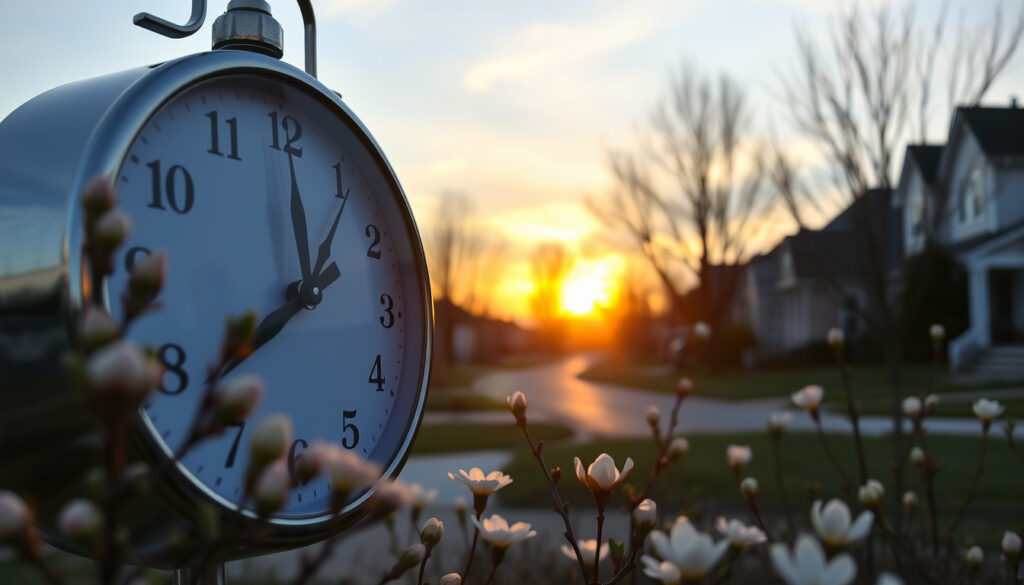
Daylight Saving Time 2026 Early: Why Clocks Change Sooner
If you’re already dreading the lost hour of sleep in 2026, you may have noticed something odd: the spring forward is arriving a day earlier than usual. Here is why that shift happens, listing exact dates for the US, UK, and Ireland, and reviewing what health science says about the biannual time change.
2026 US spring forward date: March 8 ·
2026 US fall back date: November 1 ·
Change from 2025 spring forward: 1 day earlier ·
2026 Ireland spring forward date: March 29 ·
2026 Ireland fall back date: October 25 ·
2026 UK BST start: March 29
Quick snapshot
- US DST starts March 8, 2026 (U.S. Naval Observatory)
- US DST ends November 1, 2026 (U.S. Naval Observatory)
- Ireland DST starts March 29, 2026 (Citizens Information Ireland)
- Whether DST will be made permanent in the US or EU
- Long-term health effects of semi-annual time changes
- Full extent of regional exceptions in Canada
- 2026 US spring forward is 1 day earlier than 2025 (U.S. Naval Observatory)
- 2026 Ireland/UK spring forward remains on last Sunday in March (Citizens Information Ireland)
- Spring forward in most US states: March 8, 2026 (U.S. Naval Observatory)
- Fall back in US: November 1, 2026 (U.S. Naval Observatory)
- Ireland/UK spring forward: March 29, 2026 (Citizens Information Ireland)
Seven facts, one pattern: the US starts DST earlier than Europe in 2026, while Ireland and the UK stick to their last‑Sunday rule. Here’s the exact breakdown.
| Label | Value |
|---|---|
| US spring forward | March 8, 2026 |
| US fall back | November 1, 2026 |
| Ireland spring forward | March 29, 2026 |
| Ireland fall back | October 25, 2026 |
| UK BST start | March 29, 2026 |
| UK BST end | October 25, 2026 |
| Why early? | Calendar rule: second Sunday in March falls on March 8, one day earlier than 2025 (U.S. Naval Observatory) |
Are clocks set to change earlier in 2026?
Yes, in the United States the spring forward is one day earlier than in 2025. The shift is purely a matter of calendar mechanics. Since 2007, US daylight saving time has begun on the second Sunday in March and ended on the first Sunday in November, as established by the Energy Policy Act of 2005 (U.S. Naval Observatory). In 2025 the second Sunday was March 9; in 2026 it falls on March 8. This calendrical quirk means the “earlier” change is not a policy decision but a natural calendar slide.
Why is 2026 an important year?
Beyond the calendar shift, 2026 continues a long‑running debate about permanent DST. Multiple bills have been introduced in Congress (the Sunshine Protection Act) but none have become law. The American Academy of Sleep Medicine (AASM, the leading sleep‑medicine body) has stated that existing data support eliminating seasonal time changes in favor of a fixed year‑round time, favoring permanent standard time over permanent DST (PubMed Central). So while 2026 itself is not a legislative landmark, it is another year in which the public and lawmakers face the same unsettled question.
When does daylight saving time end permanently?
There is no current federal law that ends DST permanently. The Sunshine Protection Act, which would make DST permanent nationwide, passed the Senate in 2022 but stalled in the House. Pew Research Center (nonpartisan research group) notes that most of the world’s countries do not observe DST, and the US remains in a wait‑and‑see position (Pew Research Center). In Europe, the EU has discussed abolishing seasonal time changes since 2018, but no directive has been implemented.
The 2026 earlier start may feel like a harbinger of permanent change, but until Congress acts, the twice‑yearly switch remains law.
The implication: Americans face a routine disruption with no legislative fix in sight; the calendar, not policy, drives the early shift.
What date do clocks go forward in 2026?
In the United States, clocks spring forward one hour at 2:00 a.m. local time on March 8, 2026. This schedule applies to all states that observe DST, except Hawaii and most of Arizona, which do not change (U.S. Naval Observatory). In Ireland and the United Kingdom, clocks spring forward at 1:00 a.m. GMT on March 29, 2026, as per Citizens Information Ireland (Irish government information service) (Citizens Information Ireland).
When should I change the clock in 2026?
Set all analog and digital clocks forward one hour before you go to bed on Saturday, March 7 (US) or Saturday, March 28 (Ireland/UK). Smartphones and computers typically update automatically.
How to prepare for the spring forward
- Note the date: Saturday, March 7 for US; March 28 for Ireland/UK.
- Set a reminder to change clocks before bed that Saturday.
- Adjust your alarm clock to the new time after setting clocks forward.
- Go to bed 15–30 minutes earlier on Friday and Saturday to offset the lost hour.
- Maximize morning sunlight exposure on Sunday to reset your circadian rhythm.
Do I get an extra hour in bed when the clocks go back?
No – the spring forward in March means you lose one hour of sleep. You gain that extra hour when clocks fall back in autumn: November 1 in the US, October 25 in Ireland/UK.
For the roughly 300 million Americans who observe DST, the loss of even one hour of sleep can ripple into Monday morning traffic and work performance. Planning ahead helps.
The catch: regardless of preparation, the spring transition disrupts circadian rhythms for several days, especially for those with irregular sleep schedules.
When do the clocks go back in 2026?
In the United States, clocks fall back one hour at 2:00 a.m. local time on November 1, 2026. In Ireland and the UK, clocks fall back at 2:00 a.m. (1:00 a.m. GMT) on October 25, 2026 (U.S. Naval Observatory; Citizens Information Ireland). On the fall‑back night, you get an extra hour of sleep – a welcome contrast to the spring transition.
Do I get an extra hour in bed when the clocks go back?
Yes. When clocks revert from DST to standard time in autumn, you effectively get a 25‑hour day. Set clocks back one hour before bed on Saturday, October 31 (US) or Saturday, October 24 (Ireland/UK).
The extra hour is short‑lived. The earlier sunsets that follow can affect mood and energy, especially in northern latitudes where darkness arrives by late afternoon.
What this means: the autumn change gives a brief sleep bonus but ushers in darker afternoons that can dampen energy levels for months.
What date do the clocks move forward in Ireland?
Ireland moves clocks forward on March 29, 2026, at 1:00 a.m. GMT, switching to Irish Standard Time (IST). The fall back to Greenwich Mean Time occurs on October 25, 2026 at 2:00 a.m. IST (Citizens Information Ireland). Note that Ireland and the UK always change on the same weekend, aligning with the European Summer Time schedule.
When do clocks change in Ireland?
Twice a year: spring forward on the last Sunday of March, fall back on the last Sunday of October. In 2026 those dates are March 29 and October 25.
What is the darkest month in Ireland?
December is the darkest month in Ireland due to its high latitude (approximately 53°N in Dublin). The winter solstice brings only about 7.5 hours of daylight. The shift from DST to standard time in late October means afternoons grow noticeably darker in November and December.
For Irish residents, the October clock change signals the approach of the year’s shortest days – a transition many find harder than the spring loss of sleep.
The pattern: Ireland’s spring forward comes three weeks after the US, giving a longer adjustment window but still leading into the darkest period of the year.
Can time change affect blood pressure?
Evidence suggests yes. A systematic review published in PubMed Central (National Library of Medicine) found that the spring transition is associated with elevated risk of cardiovascular events, including stroke and heart attack. Researchers reported an approximate 10 % increase in relative risk for some cardiovascular diseases among inpatients under 20, and a 30 % rise in injury risk in certain analyses (PubMed Central). Northwestern Medicine (academic medical center) notes that sleep disruption from the spring shift can temporarily raise blood pressure and increase fatigue (Northwestern Medicine). Rush University Medical Center (Chicago hospital and research institute) adds that traffic accidents spike in the days following the spring time change (Rush University Medical Center).
Why did the clocks not go back in 1968?
The United Kingdom experimented with permanent British Summer Time (BST) from 1968 to 1971. During this period, clocks did not fall back in autumn 1968, and the country remained on BST year‑round. The experiment ended after public dissatisfaction, particularly from northern regions where winter mornings grew dangerously dark. WebExhibits (DST history resource) documents this period as one of the few modern attempts at permanent DST (WebExhibits).
“The systematic review found elevated risk clusters after DST transitions, including cardiovascular diseases, injuries, and mental and behavioral conditions.”
“Most Americans in states that observe DST will switch on March 8, 2026, while Hawaii and most of Arizona do not observe daylight saving time.”
The implication: the spring transition carries measurable health risks, while the autumn change is less harmful but still disrupts circadian rhythms.
Timeline of DST changes
- March 9, 2025 – US DST start (reference year) (U.S. Naval Observatory)
- March 8, 2026 – US DST start (early, one day earlier) (U.S. Naval Observatory)
- March 29, 2026 – Ireland and UK DST start (Citizens Information Ireland)
- October 25, 2026 – Ireland and UK DST end (Citizens Information Ireland)
- November 1, 2026 – US DST end (U.S. Naval Observatory)
- 1968–1971 – UK permanent BST experiment (WebExhibits)
What we know and what remains uncertain
Confirmed facts
- US DST start and end dates for 2026 from U.S. Naval Observatory
- Ireland/UK dates from Citizens Information Ireland and UK government
- Health risks (heart attack, stroke, injury) are documented in peer‑reviewed studies (PubMed Central)
What’s unclear
- Whether DST will be made permanent in the US or EU – no recent legislative progress
- Long‑term health effects of semi‑annual time changes – most studies focus on the acute transition
- Full scope of regional exceptions (e.g., Saskatchewan, parts of Canada) – varies by province
For US households and lawmakers, the implication is straightforward: the March 8 change is not just a date on the calendar – it’s a recurring public‑health stressor that health organizations increasingly say should be eliminated. For Ireland and the UK, the later March 29 switch at least gives more time to adjust after the US transition. The pattern is clear: the earlier the spring forward, the longer the misalignment with circadian rhythms in the weeks that follow.
For US lawmakers, the choice is clear: either accept the annual disruption documented by medical research or move to permanent standard time, as the American Academy of Sleep Medicine recommends (PubMed Central). For individuals, planning ahead – gradually adjusting sleep schedules, maximizing morning light – can soften the blow. The 2026 earlier start is a reminder that while the calendar dictates the date, preparation can ease the transition.
abcnews.com, facebook.com, premierclocks.com, en.wikipedia.org, nbcnews.com
For Americans, the shift to daylight saving time in 2026 begins on March 8, 2026 start, a date that traditionally falls on the second Sunday of March.
Frequently asked questions
Why does DST start earlier in 2026?
Because US DST begins on the second Sunday in March, and in 2026 that falls on March 8, one day earlier than 2025. It’s a calendar quirk, not a policy change.
Do all US states observe DST?
No. Hawaii and most of Arizona do not observe DST. The rest of the country switches on March 8 and November 1 in 2026.
How does the darkest month in Ireland relate to DST?
December is the darkest month. DST ends in late October, so afternoons get darker earlier, which can affect mood and energy levels.
What is the history of DST in the UK?
The UK has observed BST since 1916, except for a permanent BST experiment from 1968 to 1971 when clocks did not go back in 1968.
How does DST impact health beyond blood pressure?
Studies show increased risks of stroke, heart attack, traffic accidents, and injuries in the days after spring forward. The autumn change is generally less harmful.
Are there any legislative efforts to end DST permanently?
No permanent end is enacted. The Sunshine Protection Act stalled in Congress; EU efforts are also on hold.
Is there a recommended time to change clocks before bed?
Set clocks forward one hour before bed on Saturday, March 7 (US) or March 28 (Ireland/UK). For the fall back, set clocks back on Saturday, October 31 (US) or October 24 (Ireland/UK).
Editor’s note: This article was updated with the latest research on DST health impacts. When Does College Football Start in 2026? and How to Lower LDL Cholesterol: Quick Diet & Lifestyle Tips offer related reading on timing and wellness.
More related posts
 FedEx Print & Go: How to Print at FedEx with a Retrieval Code
 Rooms To Go Near Me: Find Stores, Compare with Ashley, and Save
 Illinois Secretary of State Services, Appointments & DMV Guide
 Seattle Storm vs Dallas Wings: Player Stats June 2026
 Coach Outlet Near Me: Find Stores & Compare Brands
 Notre Dame vs Stanford: Rivalry, 2025 Score & Betting Odds
 Best Webcams for Zoom in 2026: Expert-Tested Picks
 Cleveland Cavaliers vs Boston Celtics: Player Stats 2025-26