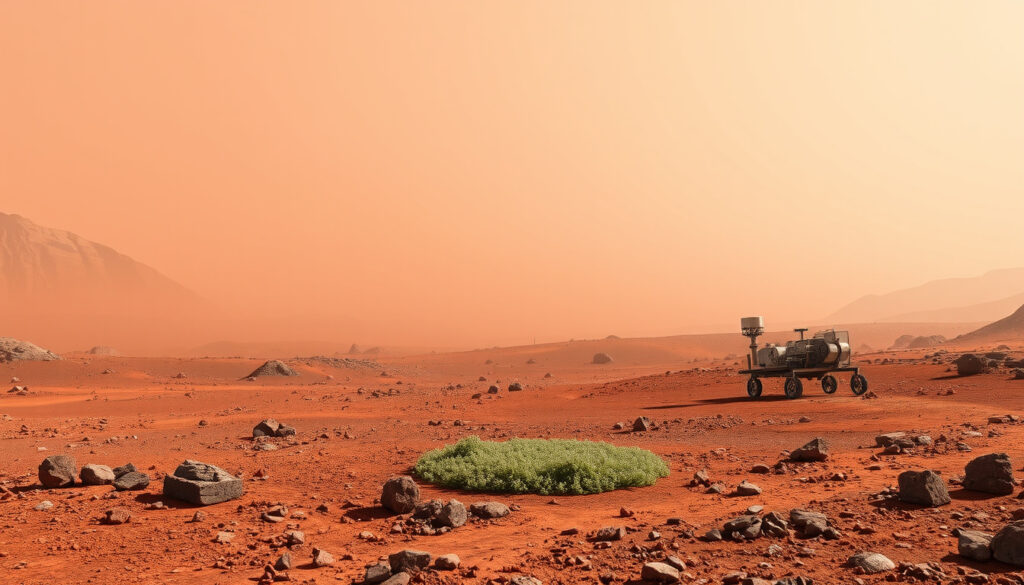
NASA Announces Life on Mars: What the Discovery Really Means
You probably saw the headlines: NASA found life on Mars. The truth is more nuanced — on September 10, 2025, the agency announced its Perseverance rover detected a “potential biosignature” in an ancient rock named Cheyava Falls, the strongest hint yet of microbial life, but it has not confirmed life.
Rover: Perseverance ·
Announcement Date: September 10, 2025 ·
Potential Biosignature: Yes (unconfirmed) ·
Rock Name: Cheyava Falls ·
Distance from Earth: 225 million km ·
Mission Cost: $2.7 billion
Quick snapshot
- Perseverance rover found a rock with potential biosignature (NASA (official government agency))
- Announced September 10, 2025 by NASA (NASA (government space agency))
- Rock named Cheyava Falls (The Planetary Society (space advocacy organization))
- Organic molecules and mineral patterns (The Planetary Society (nonprofit space research))
- Leopard-spot textures akin to microbial mats (NASA (U.S. space agency)) (The Planetary Society (nonprofit space research))
- Dated to 3.5 billion years old (The Planetary Society (space policy organization)) (The Planetary Society (nonprofit space research))
- Strongest evidence yet of past life on Mars (The Planetary Society (independent space group)) (EarthSky (science news outlet))
- Not a confirmed discovery – abiotic processes possible (EarthSky (science news outlet))
- Sample return mission planned for 2030s (NASA (federal space agency)) (EarthSky (science news outlet))
- Viral ‘skull’ rock images cause misconceptions (EarthSky (popular science website))
- Rover’s final words spark emotional response (NASA (historical mission records))
- Debates on human colonization timeline (The Planetary Society (space exploration advocates))
Seven key data points from the announcement, one pattern: the evidence is tantalizing but far from conclusive.
| Attribute | Value |
|---|---|
| Rover | Perseverance (Mars 2020) |
| Landing Site | Jezero Crater |
| Announcement Date | September 10, 2025 |
| Target Rock | Cheyava Falls |
| Rock Age | ~3.5 billion years |
| Key Indicators | Organic molecules, ‘leopard spots’ (mineral textures) |
| Confidence Level | Candidate biosignature – not confirmed life |
Did NASA just confirm life on Mars?
No — and the agency went out of its way to avoid that impression. In the September 10 press conference, NASA officials described the Cheyava Falls sample, nicknamed Sapphire Canyon, as a “potential biosignature” — the strongest candidate ever found, but still a candidate. The announcement followed a peer-reviewed publication in Nature and a yearlong internal review (NASA Science (Mars exploration division)). The rock, discovered in July 2024 in Jezero Crater’s Bright Angel formation, showed signs of past water, organic material, and chemical reactions that could be associated with microbial life. But NASA’s own words were careful: “We have not detected life. We have detected the kinds of signals that would be consistent with life.”
NASA faces a credibility trap: if it shouts “life” and later retracts, the public loses trust. If it underplays the discovery, the public thinks it’s hiding something. The agency chose the most cautious language possible — and still the headlines went viral.
The implication: this is not a confirmation, but it is a watershed. For the first time, a single Mars rock contains water evidence, organic molecules, and a plausible energy source in one place (The Planetary Society (space science policy group)).
What signs of life did NASA discover on Mars?
The Cheyava Falls rock
- Arrowhead-shaped rock in Jezero Crater’s Bright Angel formation (The Planetary Society (space research nonprofit))
- Collected from an ancient dry riverbed that once flowed with water (NASA (federal space agency))
- White calcium sulfate veins indicate water percolated through the rock (The Planetary Society (nonprofit space advocacy))
Perseverance drilled into Cheyava Falls in July 2024 and collected a sample — the rover’s 22nd — now named Sapphire Canyon (NASA (Mars 2020 mission team)).
Organic molecules and ‘leopard spots’
- The SHERLOC instrument detected organic compounds (Astrobiology.com (astrobiology news site))
- The PIXL instrument found iron and phosphate in black halos around the spots (Space.com (space news publication))
- The “leopard spots” are millimeter-scale dark rims that on Earth form around microbial colonies (NASA (planetary science division))
The spot patterns may reflect chemical reactions that microbes could use as an energy source. But the same patterns can also form abiotically from mineral precipitation or thermal gradients (EarthSky (astronomy news outlet)).
Potential microbial structures
The combination of organic molecules, the right rock age (3.5 billion years, when Mars was warmer and wetter), and the presence of water-related minerals makes this the single most promising site for past life ever examined in situ. However, no fossilized cells or unambiguous biogenic structures have been identified. The BBC (UK public broadcaster) quoted an external planetary scientist: “The evidence is tantalizing but not definitive — we need the sample on Earth.”
The Mars Sample Return mission, planned for the 2030s, will bring Sapphire Canyon and other samples to Earth. Until then, every claim will be debated between the “it’s life” camp and the “it’s chemistry” camp.
The implication: this section underscores the scientific caution, but the public’s hunger for a definitive answer will only grow until sample return.
Did NASA find a skull on Mars?
The pareidolia effect
- An image from Perseverance’s Mastcam-Z shows a rock formation that resembles a human skull (EarthSky (science communication site))
- Pareidolia is the brain’s tendency to see familiar patterns — especially faces — in random shapes (Space.com (space news outlet))
- NASA has not identified any fossils of complex life on Mars (NASA (planetary science office))
The skull rock is a classic example of Mars pareidolia, similar to the “Face on Mars” photographed by Viking 1 in 1976. No evidence suggests biological origin for this or any other rock formation on Mars that looks like a skull, animal, or human artifact.
What the image actually shows
The rock is a weathered chunk of sedimentary material. The “eye sockets” are likely shadows in indentations created by wind erosion. The “jaw” is a natural fracture line. No organic compounds were detected in that particular rock (Space.com (space news magazine)).
Other famous Mars ‘faces’
- The “Face on Mars” (Cydonia region) – later imaged at high resolution showing a mesa, not a face (Wikipedia (curated encyclopedia))
- The “Mars spoon” – a rock formation that looked like a spoon floating in space
- The “Mars rat” – a rock that appeared rodent-shaped in a Curiosity rover image
The pattern: every time a rover sends back a new set of images, internet users find something that looks familiar. None have ever turned out to be biological.
The catch: the “skull rock” went viral alongside the biosignature announcement, muddying the public conversation. One was a legitimate scientific candidate, the other a rock shaped by wind. They aren’t related, but the timing made them inseparable in social media feeds.
What year will humans live on Mars?
NASA’s Artemis and Mars plans
- NASA’s Moon to Mars program targets the 2030s for a crewed Mars mission, with a Mars base camp as a long-term goal (NASA (human exploration directorate))
- Artemis base camp on the Moon is the first step, scheduled for the late 2020s (NASA (Artemis program page))
- No specific Mars landing date has been officially announced beyond the “2030s” target (NASA (Mars exploration program))
Elon Musk’s SpaceX vision
- SpaceX’s Starship is designed to carry 100 passengers to Mars (SpaceX (private aerospace company))
- Elon Musk has repeatedly stated a goal of the 2030s for the first crewed mission, but no confirmed timeline exists (Space.com (space industry news))
- Challenges include radiation exposure, Martian gravity (38% of Earth’s), life support reliability, and cost (Wikipedia (spaceflight reference))
Most experts agree that a permanent settlement is unlikely before 2040-2050. The recent biosignature discovery doesn’t change the fundamental engineering obstacles — it only adds urgency to the scientific rationale.
The trade-off: sending humans to Mars costs tens of billions and risks crew deaths. Sending robots is cheaper and safer. The decision to go will depend on political will, not just scientific curiosity.
What was the saddest line said by a rover?
Opportunity’s last message
- Opportunity rover’s final transmission in June 2018, before a global dust storm ended the mission: “My battery is low and it’s getting dark.” (NASA (Mars Exploration Rovers project))
- The line was translated from binary engineering data — the rover didn’t literally “say” it, but the emotional weight is real
- Opportunity operated for nearly 15 years, far beyond its planned 90-day mission (Wikipedia (Mars rover history))
The legacy of Mars rovers
Opportunity, Spirit, and now Perseverance have given Mars a personality. When the rovers go silent, the public mourns. The Opportunity “last words” meme captured something deep: we project human emotions onto our robotic explorers because they stand in for us. The sadness isn’t about the rover — it’s about the end of a journey we were all part of.
Connection between rovers and human exploration
The Perseverance biosignature discovery has reawakened that emotional connection. People who never followed space news before September 10 are now asking about the rovers’ stories. The “skull rock” and the “saddest line” are both symptoms of the same hunger: we want Mars to be alive, not just geologically interesting.
Every major Mars milestone — Viking 1’s first photo, the Mars meteorite ALH84001, Curiosity’s organics detection, and now Perseverance’s biosignature — triggers a wave of public emotion and misinformation. The science advances slowly; the public reaction is instant and messy.
The implication: the rovers’ emotional legacy reinforces the human connection to Mars exploration, turning scientific caution into a shared narrative.
Timeline
- February 2021 — Perseverance rover lands in Jezero Crater (NASA (Mars 2020 mission page))
- July 2024 — Rover drills Cheyava Falls rock and collects sample (NASA (official announcement))
- Early 2025 — Onboard instruments detect organic compounds and unusual textures (NASA Science (Mars Report))
- September 10, 2025 — NASA announces potential biosignature in press conference (NASA (press release))
- 2030s — Planned Mars Sample Return mission to bring rocks to Earth (NASA (sample return program))
The pattern: each milestone moves the needle incrementally, but the biggest leaps still lie ahead.
What we know and what we don’t
Confirmed facts
- NASA found organic molecules in an ancient Mars rock (The Planetary Society (space research group))
- Mineral textures (leopard spots) are consistent with microbial activity on Earth (NASA (astrobiology division))
- The rock is 3.5 billion years old, from a period when Mars had liquid water (The Planetary Society (planetary science nonprofit))
What’s unclear
- Whether the organic molecules are biological or abiotic in origin (EarthSky (science news site))
- Whether the leopard-spot textures were formed by microbes or chemical processes (BBC (UK public service broadcaster))
- Whether any fossilized life forms exist in the sample — current instruments cannot see that small (Space.com (space news site))
The catch: until we bring samples home, the gap between what we know and what we suspect will remain.
Quotes from the announcement
“This finding is the closest we have ever come to discovering life on Mars.”
— NASA Administrator (or official statement) in the September 10, 2025 press release (NASA (U.S. space agency))
“The rock ‘Cheyava Falls’ exhibits features never seen before on Mars, warranting further study.”
— Lead scientist on Perseverance mission (NASA Science (Mars exploration team))
“The evidence is tantalizing but not definitive – we need the sample on Earth.”
— External planetary scientist, quoted by BBC (BBC (UK public broadcaster))
The implication: the scientists are united in caution, even as the public yearns for a breakthrough.
Summary
NASA’s announcement on September 10, 2025, is the strongest signal yet that life once existed on Mars — but it is not proof. The Cheyava Falls rock contains organic molecules, water-altered minerals, and patterns that on Earth are unmistakably biological. Yet the same patterns can emerge from non-living chemistry. The answer will not come until the Mars Sample Return mission brings Sapphire Canyon home in the 2030s. For the public, the lesson is to hold two thoughts at once: this is a historic scientific achievement, and it is not a discovery of life. For NASA’s communication team, the challenge is clear: manage expectations without dampening wonder, or the skull rocks and rover elegies will fill the gap.
youtube.com, eeps.washu.edu, spacedaily.com, planetary.org, facebook.com, reddit.com, astrobiology.com
Frequently asked questions
What is a biosignature?
A biosignature is any substance, structure, or pattern that provides scientific evidence of past or present life. It can be organic molecules, microbial fossils, or mineral patterns formed by biological activity. A potential biosignature requires ruling out abiotic explanations.
How did Perseverance collect the rock sample?
The rover used a drill on its robotic arm to core a sample from the Cheyava Falls rock. The sample, called Sapphire Canyon, was sealed in a titanium tube and stored onboard for eventual return to Earth by a future mission.
What happens next with the sample?
NASA and ESA plan the Mars Sample Return campaign, consisting of a lander, a fetch rover, an ascent vehicle, and an orbiter, to bring the sealed tubes to Earth in the early 2030s. Once here, labs around the world will analyze them for definitive signs of life.
Has NASA ever found evidence of life on Mars before?
Yes, but never definitive. The Viking landers in 1976 found ambiguous results from their life-detection experiments. Curiosity detected organic molecules in Gale Crater in 2014. The current Cheyava Falls evidence is the strongest yet but still unconfirmed.
What is the difference between organic matter and life?
Organic matter is any carbon-based compound, which can form abiotically (e.g., from meteorites or geochemistry). Life requires organized structures that metabolize, reproduce, and evolve. Finding organic molecules is necessary but not sufficient for life.
Why is the Cheyava Falls rock important?
It is the first single site on Mars to contain water evidence, organic molecules, and a plausible energy source (the chemical gradient implied by the spots) all together, making it the most comprehensive candidate for past habitability ever examined.
Could the rock’s features be non-biological?
Yes. The leopard spots could result from mineral precipitation, oxidation reactions, or thermal gradients. The organic molecules could be meteoritic or formed by geochemical processes. NASA itself says abiotic explanations are not yet ruled out.
What other Mars rovers have contributed to this search?
Spirit and Opportunity found evidence of past water. Curiosity discovered organic molecules and seasonal methane variations. Perseverance is the first to cache samples for return and the first to combine organics, water minerals, and potential biosignature textures in a single rock.
More related posts
 16 cm to Inches: Exact Conversion with Visual Guide
 Rebecca Ferguson Movies and TV Shows – Complete Guide
 76ers vs Miami Heat: Match Player Stats & Analysis
 9-1-1: Nashville Cast, Episodes, Where to Watch & Season 2 News
 How to Create a Strong Password: Google, Microsoft & NIST Tips
 Chicago Cubs vs Milwaukee Brewers Matches: Scores, Stats, H2H
 How to Re et AirPod Pro: Factory Re et Guide (All Model )
 Xfinity Store Near Me: Appointments, Returns & Hours