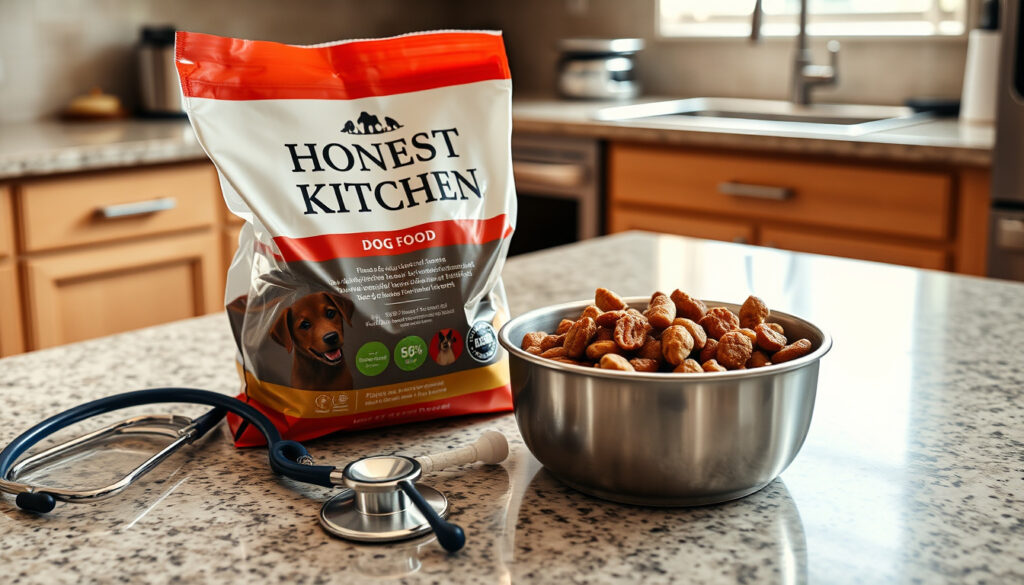
Honest Kitchen Dog Food Review: Do Vets Recommend It?
Standing in the pet food aisle is frustrating when trying to find something truly healthy for your dog. The Honest Kitchen promises human-grade ingredients, but we examined vet opinions, processing, and comparisons to see if it delivers.
Vet Recommended: Yes, by brand and many pet owners (mixed professional consensus) ·
Human Grade Certified: Yes ·
Price Range (per lb): $2.50 – $4.00 ·
Protein Content (typical): 25% – 30% ·
AAFCO Approved: Yes, for all life stages
Quick snapshot
- Human-grade certified with AAFCO compliance (AAFCO (pet food regulatory body))
- Made in USA in human food facility (The Honest Kitchen (brand website))
- No recalls since founding in 2002 (The Honest Kitchen (brand website))
- Exact protein digestibility compared to extruded kibble
- Whether it is suitable for every dog’s specific health condition
- Long-term health outcomes of exclusive human-grade dehydrated feeding
- 2002: Founded by Lucy Postins (The Honest Kitchen (brand website))
- 2020: Earned Human Grade certification under FDA human food standards (U.S. FDA (federal regulator))
- Ongoing expansion into wet food and toppers
- Growing interest from owners seeking raw-alternatives without raw risks
The following table summarizes key facts about The Honest Kitchen.
| Attribute | Details |
|---|---|
| Founded | 2002 |
| Headquarters | Louisville, Kentucky, USA |
| Product Types | Dehydrated, Clusters, Wet food, Toppers |
| Certifications | Human Grade certified, AAFCO compliant |
| Recalls (last 10 years) | None |
| Price Range | $2.50 – $4.00 per lb |
Do vets recommend The Honest Kitchen dog food?
The brand’s own marketing says it is “vet recommended,” but that label hides a broader split in veterinary opinion. A look at the evidence shows why some vets back it and others hold back.
What specific veterinary organizations endorse Honest Kitchen?
- The Honest Kitchen states on its brand website that its products are “vet recommended.” No major veterinary association—such as the WSAVA—lists Honest Kitchen as a formally endorsed brand.
- Dr. Justine Lee, a board-certified veterinary specialist, reviewed the food and called it “safe” and noted that ingredients come from the human food chain rather than a rendering plant (Dr. Justine Lee, DVM (veterinary specialist)).
What do independent vet reviews say?
Several veterinary nutritionists point out that “human-grade” does not automatically mean better for a dog’s specific health needs. The FDA also warns that the term U.S. FDA (federal regulator) does not imply greater safety or nutritional superiority. Some vets recommend Honest Kitchen for dogs with food allergies or sensitive stomachs because of its minimal ingredient list, but they often caution that the premium price isn’t justified for every pet.
How does Honest Kitchen compare to vet-recommended brands like Royal Canin or Hill’s?
Brands like Hill’s Science Diet and Royal Canin are backed by decades of feeding trials and therapeutic formulas for specific conditions. Honest Kitchen lacks that extensive clinical research, which is why most vets place it as a second-tier choice. A PetMD roundup lists Honest Kitchen in certain categories, but not as a top pick for all dogs.
Vets who recommend Honest Kitchen do so because of ingredient quality; those who prefer traditional brands point to the lack of long-term clinical data. The choice depends on whether you value “human-grade” sourcing over research-backed formulations.
Is The Honest Kitchen a good brand of dog food?
Judging “good” means weighing ingredient quality, safety, and value. On all three fronts, the brand delivers some clear wins—and a few trade-offs.
What are the pros and cons of Honest Kitchen dog food?
Upsides
- Human-grade ingredients from human food supply chain (The Honest Kitchen (brand website))
- No artificial preservatives, colors, or flavors
- Certified B Corporation (B Lab (certification body))
- No recalls since 2002
Downsides
- Premium price ($2.50–$4.00/lb) compared to standard kibble
- Less clinical research backing than brands like Hill’s or Royal Canin
- Some consumer complaints about packaging and cost (RateItAll (consumer review site))
How does it score on ingredient quality, nutrition, and safety?
The brand uses human-grade beef, chicken, or fish as first ingredients, and recipes are AAFCO approved for all life stages (AAFCO (pet food regulatory body)). The dehydration process (low heat) avoids the high-temperature extrusion used by most dry foods, which some experts believe preserves more natural nutrients.
Are there any reported issues like recalls or complaints?
No recalls have been documented in the brand’s 20+ year history. Consumer reviews cite occasional packaging issues and the high price as the main drawbacks, but no widespread safety concerns.
A 20-year recall-free record is rare in the pet food industry. That track record alone makes Honest Kitchen a safer bet than many conventional brands, even if the price deters budget-conscious owners.
Is The Honest Kitchen dog food processed?
Yes—but not in the way you might think. The type of processing matters more than whether processing exists at all.
What does ‘human-grade’ processing mean?
The FDA defines “human-grade” as meaning every ingredient is stored, handled, processed, and transported in a manner compliant with human food regulations (U.S. FDA (federal regulator)). For Honest Kitchen, that means production in a USDA-inspected human food facility, not a feed-grade plant.
How does the processing compare to traditional kibble?
Conventional kibble is cooked via extrusion at temperatures above 250°F, which can degrade some vitamins and amino acids. Honest Kitchen’s dehydrated recipes use low-temperature dehydration (around 130–140°F) to remove moisture while keeping more natural nutrients intact. The Clusters line is baked rather than extruded, as described on the The Honest Kitchen Clusters page.
Does processing affect nutrient retention?
Dehydration retains more water-soluble vitamins than high-heat extrusion, but the trade-off is that the food must be rehydrated with water before serving. This adds a step for owners but avoids the ultra-processed label that many dry foods carry.
Less processing means shorter shelf life after opening—dehydrated food must be used within a few weeks, whereas kibble can last months. For owners who buy in bulk, that’s a real limitation.
The implication: owners must balance nutrient integrity with convenience and storage constraints.
What are the top 3 healthiest dog foods?
Different experts rank “healthiest” differently. Here is where Honest Kitchen lands in the broader landscape.
Where does Honest Kitchen rank among the healthiest dog foods?
On pet nutrition blogs, Honest Kitchen often appears near the top for ingredient quality. However, on B Lab (certification body) lists and some veterinary recommendations, it is considered a solid option but not the absolute leader.
What criteria determine ‘healthiest’ dog food?
The most common benchmarks: protein from named meat sources, balanced omega fatty acids, minimal fillers (corn, soy, wheat), AAFCO nutritional adequacy, and ideally feeding trials. Honest Kitchen meets all except feeding trials—the company does not conduct published clinical trials.
How do Honest Kitchen’s nutritional metrics compare to top competitors?
Let’s look at a side-by-side comparison of three leading options.
| Brand | Protein Range | Fat Range | Fiber Range | AAFCO Life Stages | Price per lb |
|---|---|---|---|---|---|
| Honest Kitchen (Cluster) | 25–30% | 12–16% | 4–5% | All life stages | $2.50–$4.00 |
| Hill’s Science Diet (Adult) | 20–25% | 12–16% | 3–4% | All life stages (by variety) | $1.50–$2.50 |
| Blue Buffalo Life Protection | 24–28% | 12–15% | 4–5% | All life stages | $1.80–$2.80 |
The pattern: Honest Kitchen offers higher protein than Hill’s, comparable to Blue Buffalo, but at a higher price point. The real differentiator is ingredient sourcing, not the raw numbers.
What is the number one vet recommended dog food?
The answer might surprise owners who lean toward “human-grade” brands.
How does Honest Kitchen compare to the number one vet recommended brand?
Hill’s Science Diet and Royal Canin consistently top lists of vet-recommended brands because of their extensive research and therapeutic diets. Honest Kitchen does not have the same level of clinical backing, which is why it rarely appears as the number one pick.
Why do vets prefer certain brands over others?
Vets prioritize brands that perform controlled feeding trials and offer formulas for medical conditions such as kidney disease, obesity, and allergies. Honest Kitchen does not produce prescription diets.
Can human-grade food ever be the top vet recommendation?
It could, if a brand invests in clinical research and therapeutic lines. For now, most vets view Honest Kitchen as a “better ingredient” choice for healthy dogs, but not a medical tool. The trade-off is clear: ingredient quality vs. clinical evidence.
Ultimately, the choice between ingredient quality and clinical evidence depends on the individual dog’s needs.
Here are the specifications at a glance.
| Attribute | Details |
|---|---|
| Brand Name | The Honest Kitchen |
| Founded | 2002 |
| Headquarters | Louisville, Kentucky, USA |
| Certifications | Human Grade certified, B Corporation, AAFCO compliant |
| Product Lines | Dehydrated, Clusters (baked), Wet food, Toppers, Broths |
| Protein Range (dry matter) | 25–30% |
| Fat Range (dry matter) | 12–16% |
| Fiber Range (dry matter) | 4–5% |
| Calories (Clusters, per cup) | Approx. 380–420 kcal |
| Recalls | None (since 2002) |
| Manufacturing | USA (Kentucky) |
What we know for sure
- Human-grade ingredients from human food chain (The Honest Kitchen (brand website))
- No recalls in over 20 years (The Honest Kitchen (brand website))
- AAFCO approved for all life stages (AAFCO (pet food regulatory body))
What remains unclear
- Exact digestibility vs. extruded kibble
- Long-term health outcomes of exclusive feeding
- Whether the price premium translates to measurable health benefits
- Whether B Corporation certification affects nutritional quality
“Our foods are made in human food facilities with ingredients that are fit for human consumption—no feed-grade ingredients, no rendering plant floors.”
— Lucy Postins, founder of The Honest Kitchen (The Honest Kitchen (brand website))
“The food appears safe. Some formulas are heat-steamed or flash heated to reduce microbial risk, and the ingredients come from the human food chain rather than a rendering plant floor.”
— Dr. Justine Lee, DVM, DACVECC (Dr. Justine Lee (veterinary specialist))
“Human-grade does not automatically equal better nutrition. It’s about sourcing, not about the nutrient profile.”
— Dr. Justine Lee, DVM (Dr. Justine Lee (veterinary specialist))
The implication for owners who are considering switching to human-grade food: you are paying for ingredient origin, not necessarily superior nutrition. For a healthy dog without medical needs, Honest Kitchen is a safe, high-quality choice. For a dog with a specific condition, the cheaper, clinically tested option may be the smarter bet.
Frequently asked questions
How is Honest Kitchen different from traditional kibble?
Honest Kitchen is dehydrated (low heat) rather than extruded (high pressure and temperature). It uses whole, human-grade ingredients and must be rehydrated before feeding. Traditional kibble is cooked at high heat and often contains rendered meals.
Does Honest Kitchen require refrigeration after opening?
Dehydrated food should be stored in a cool, dry place and used within 30 days. Once rehydrated, any uneaten portion must be refrigerated and used within 24 hours.
Is Honest Kitchen good for dogs with food allergies?
Many owners report success with Honest Kitchen’s limited-ingredient recipes. The brand offers grain-free and single-protein formulas. However, always consult your vet before switching a dog with known allergies.
What is the shelf life of Honest Kitchen dehydrated food?
Unopened, it lasts 12–18 months. After opening, the brand recommends using within 30–45 days to maintain freshness.
Can I mix Honest Kitchen with other dog foods?
Yes. The brand provides transition guidance on its blog. Gradual mixing over 7–10 days helps avoid digestive upset.
Where is Honest Kitchen manufactured?
All products are made in the USA at the company’s facility in Louisville, Kentucky.
Does Honest Kitchen offer grain-free options?
Yes. The brand has grain-free recipes as well as whole-grain formulas, covering both dietary preferences.
What is the calorie content of Honest Kitchen Clusters?
Clusters range from about 380 to 420 kcal per cup, depending on the recipe. Check the bag for exact values.
More related posts
 My Melody and Kuromi: Guide to Series, Characters & Myths
 What Is 75 Hard – Rules, Timeline and Results
 Max Keeble’s Big Move: Plot, Cast, Box Office & Streaming
 Pet Grooming Near Me: Costs, Frequency & Breed Guide (Ireland)
 Amazon Stock Price Today: Is AMZN a Buy, Sell, or Hold
 How Many Teams Make the NFL Playoffs? 14 Teams in 2025
 Appeals Court Don Lemon – Ruling Allows Claims to Trial
 File Taxes for Free: IRS, TurboTax & Ireland Guide