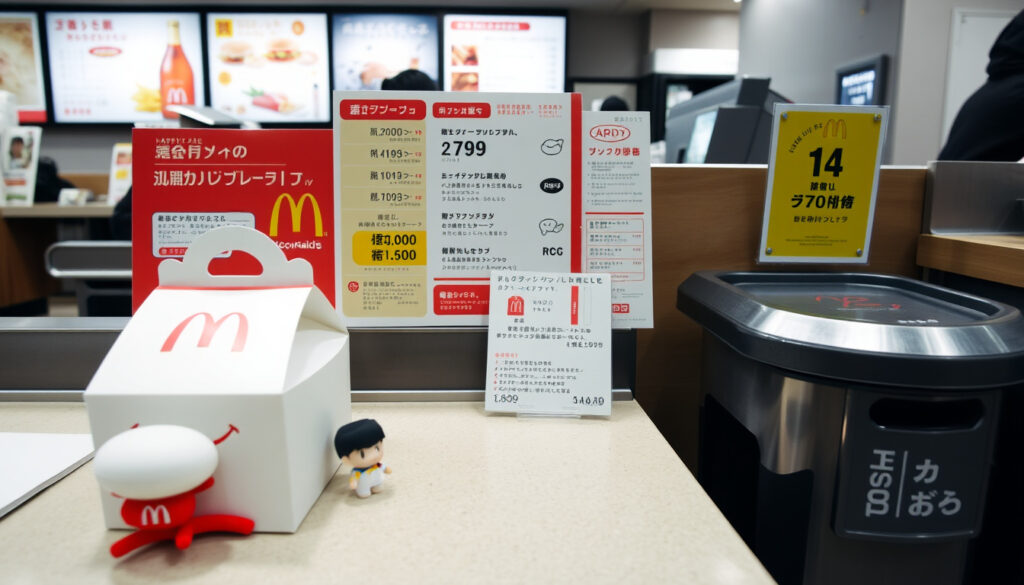
McDonald’s Japan Happy Meal Rules: Limits, Prices, Littering
There’s a peculiar scene unfolding on the streets of Tokyo and Osaka: pristine McDonald’s Happy Meals, still in their bags, abandoned on sidewalks and in train stations. The culprit isn’t waste — it’s a toy craze.
Purchase limit: 4 per person ·
Effective date: May 15, 2026 (Chiikawa launch) ·
Figure series: 6 Chiikawa figures ·
Order method: In-store or drive-thru only
Quick snapshot
- Purchase limit of 4 Happy Meals per person for Chiikawa 2026 launch (Japan Today)
- In-store or drive-thru only; no delivery or mobile orders (Japan Today)
- Chiikawa figure series of 6 figures (SoraNews24 (Japanese culture news site))
- Price range 500-600 yen (approx. $3.50-$4.20) (McDonald’s Japan official menu)
- Effectiveness of rules in curbing scalping long-term
- Future rule extensions or modifications for other toy promotions
- Long-term impact on Happy Meal sales and food waste
- September 2025: McDonald’s Japan announces anti-scalper rules for Happy Meals (Japan Today)
- May 2026: Chiikawa Happy Meal launch with 4-per-person limit (Mantan Web)
- Late May 2026: Reports of Happy Meals littering streets (Essential Japan)
- Possible tightening of rules if scalping persists
- Further character collaborations (e.g., Sanrio, Minecraft) with similar restrictions
- Public debate on food waste vs. collectible culture
Six key facts, one pattern: McDonald’s Japan is walking a tightrope between fan excitement and operational chaos. Here’s the data at a glance.
| Fact | Value |
|---|---|
| Purchase limit | 4 Happy Meals per person (Chiikawa 2026) |
| Effective date | May 15, 2026 |
| Order method | In-store or drive-thru only |
| Toy series | Chiikawa (6 figures) |
| Littering issue | Reported in Tokyo, Osaka, and other cities |
| Additional toy rule | Buy a Happy Meal first, then max 1 additional toy |
The implication: the rules are designed to make it harder for scalpers to clear shelves, but the trade-off is that genuine fans face tighter limits and fewer ordering options.
How many Happy Meals can you order at once?
During the 2026 Chiikawa promotion, McDonald’s Japan capped purchases at four Happy Meals per person per transaction on launch days, according to Japan Today (business news outlet). For the Sanrio campaign in 2025, the limit was also four per transaction, based on the same policy. The rules apply to both breakfast and regular menu hours, per Mantan Web (Japanese entertainment news).
Can an adult buy a Happy Meal?
Yes — there are no age restrictions. McDonald’s Japan explicitly allows adults to purchase Happy Meals, and the anti-scalper rules apply to all customers equally. The company’s official statement, reported by Essential Japan (Japanese lifestyle guide), asks customers “not to buy Happy Meals for resale or other commercial purposes.”
What is the fair ordering policy?
McDonald’s Japan introduced a “fair ordering policy” that includes in-store or drive-thru only, no mobile or delivery orders, and a limit of one additional toy purchase per Happy Meal bought. The policy is enforced by staff at the register. Japan Today notes that the ban on mobile orders even extends to in-store pickup, preventing pre-ordering.
For collectors, the limit means you can’t buy a full set of six figures in one trip. You’ll need multiple visits or a friend — but both strategies risk running into the same cap.
The pattern: McDonald’s Japan is effectively forcing customers to come to the store, creating a physical queue that makes bulk buying harder. It’s a deliberate inconvenience for scalpers.
What is the 2 minute rule at McDonald’s?
McDonald’s Japan has a well-known service time target of two minutes from order to handover, especially during peak hours. This target is not a formal policy but a widely reported operational benchmark, as noted by SoraNews24 (Japanese culture news site).
How does the 2 minute rule affect Happy Meal orders?
When a Happy Meal promotion launches, the 2-minute target becomes harder to meet because customers often take longer at the register asking about toys or making multiple transactions. The rule effectively pressures staff to keep lines moving, which may lead to mistakes or frustration. However, Mantan Web reports that during the Chiikawa launch, stores were instructed to prioritize order accuracy over speed, signaling a temporary relaxation of the target.
The 2-minute rule is a friction point. When limits are low and demand is high, the service target becomes a bottleneck that can spill over into customer dissatisfaction — and even conflict.
The trade-off: speed vs. fairness. McDonald’s Japan is betting that a few extra seconds per order is worth preventing scalpers from clearing the toy inventory.
Why are perfectly good Happy Meals littering the streets of Japan?
In late September 2025 and again in May 2026, social media users in Tokyo, Osaka, and other cities began posting photos of uneaten Happy Meals left on sidewalks, train platforms, and in public bins. The reason? Scalpers were buying bulk orders to get the limited-edition Chiikawa toys, then discarding the food. Essential Japan reported that McDonald’s Japan explicitly asked customers not to purchase meals for resale, but the littering continued.
What is the current Happy Meal toy?
As of May 2026, the Chiikawa series — featuring six cute characters — is the current Happy Meal toy. The promotion ran in two waves: first from May 15 to 28, then from May 29 to June 11, 2026, according to SoraNews24.
What is the Chiikawa figure?
Chiikawa ( ) is a popular Japanese manga and merchandise franchise featuring small, animal-like characters. The Happy Meal collaboration includes six different figures, each highly collectible. The limited nature of the release — combined with the relatively low price of a Happy Meal (500-600 yen) — makes it a prime target for scalpers who can resell the toys for several times the cost online.
“We have received reports of Happy Meals being discarded in public places. We sincerely apologize for the inconvenience and concern this causes.”
— McDonald’s Japan spokesperson, as quoted by Japan Today
The implication: the littering problem is a direct consequence of the scalping economy. McDonald’s Japan’s anti-scalper rules are an attempt to break the cycle, but they haven’t stopped the food waste entirely.
How much is a Happy Meal in Japan?
A Happy Meal in Japan costs between 500 and 600 yen (roughly $3.50 to $4.20 USD), depending on the location. This price includes a main item (such as a hamburger or chicken nuggets), a side of fries or yogurt, a drink, and the toy. McDonald’s Japan’s official menu lists the price as standard nationwide, though regional variations may apply.
Is the price the same across Japan?
Yes, the base price is consistent across most McDonald’s Japan locations, but some remote or tourist-heavy areas may see slight differences. The toy is included in the price, so no extra charge for the character figure. Essential Japan notes that the price makes Happy Meals an affordable entry point for collectors, which is part of the reason scalpers target them.
If McDonald’s Japan raises the price of Happy Meals during future promotions, it could reduce the scalping incentive — but it might also price out families who rely on the meal as an affordable option.
The pattern: the low price is both a draw and a vulnerability. At 500 yen, a Happy Meal is cheaper than a single Chiikawa figure on the resale market (often 2,000 yen or more).
What’s different about McDonald’s in Japan?
McDonald’s Japan has a menu that diverges significantly from its US counterpart. Teriyaki burgers, shrimp burgers, and seasonal items like the “Gratin Burger” are staples. The company also tailors its Happy Meal toys to local pop culture franchises — Chiikawa, Sanrio, Pokémon — rather than the global movie tie-ins often seen in the West. SoraNews24 highlights that the Japanese Happy Meal is treated as a collectible event, not just a kids’ meal.
Is McDonald’s in Japan healthier?
Japan has stricter nutritional labeling standards than many countries. McDonald’s Japan displays calorie counts prominently on all menus, and the Happy Meal includes smaller portions by default. However, the nutritional content is similar to US versions — the difference is more in portion size and labeling transparency. Japan Today notes that the Japanese government’s health guidelines influence menu offerings.
Does Japan like McDonald’s?
Absolutely. Japan is McDonald’s third-largest market by number of restaurants, with over 3,000 locations. The chain’s ability to adapt to local tastes — including seasonal menu items and limited-edition character toys — has made it a cultural staple. Mantan Web reports that the Chiikawa Happy Meal launch saw lines forming outside stores before opening.
“I queued for 45 minutes just to get one figure. The staff were polite but clearly stressed. They asked everyone to limit orders to four, but some people were buying full sets.”
— Social media user in Tokyo, as quoted by Essential Japan
The pattern: McDonald’s Japan’s success is built on localization, but that same localization creates a scalping ecosystem that the company is still learning to manage.
Timeline
Key events in the evolution of McDonald’s Japan Happy Meal rules.
- September 2025: McDonald’s Japan announces anti-scalper rules for Happy Meals, including purchase limits and in-person ordering requirements (Japan Today)
- May 15, 2026: Chiikawa Happy Meal launch with 4-per-person limit, mobile app voucher required on launch days (Mantan Web)
- Late May 2026: Reports of Happy Meals littering streets in Tokyo, Osaka, and other cities (Essential Japan)
- June 2026: Public discussion and media coverage of anti-scalper measures and food waste issues
The timeline shows that despite early rules, the problem escalated quickly, underscoring the challenges of curbing scalper behavior.
Confirmed facts vs. What’s unclear
Confirmed facts
- Purchase limit of 4 Happy Meals per person (Japan Today)
- In-person order requirement (no delivery, no mobile orders) (Japan Today)
- Chiikawa toy series of 6 figures (SoraNews24)
- Price range 500-600 yen (McDonald’s Japan official menu)
- Littering incidents in multiple cities (Essential Japan)
What’s unclear
- Effectiveness of rules in curbing scalping long-term
- Future rule extensions or modifications for other toy promotions
- Long-term impact on Happy Meal sales and food waste
- Effectiveness of the app voucher system on launch days
- Impact on staff workload and store operations
The confirmed facts are well-documented, while the unclear points highlight gaps in the current understanding of the problem’s scope.
Quotes
“We have received reports of Happy Meals being discarded in public places. We sincerely apologize for the inconvenience and concern this causes.”
— McDonald’s Japan spokesperson, via Japan Today
“I queued for 45 minutes just to get one figure. The staff were polite but clearly stressed. They asked everyone to limit orders to four, but some people were buying full sets.”
— Social media user in Tokyo, as quoted by Essential Japan
The contrast between the company’s polite apology and the customers’ frustration captures the core tension: a beloved product that’s become a source of stress and waste.
Summary
McDonald’s Japan’s Happy Meal rules are a fascinating case study in how a global brand adapts to local fan culture and the unintended consequences of collectible marketing. The purchase limits, in-person requirements, and mobile app voucher system are designed to stop scalpers, but they also frustrate honest customers and create operational pressure on staff. The littering of discarded Happy Meals is a stark reminder that when a product becomes a commodity for resale, the food itself is treated as waste. For McDonald’s Japan, the challenge is clear: balance the joy of limited-edition toys with the responsibility to serve food, not frustration. For collectors, the choice is clear: either wait in line, pay a scalper, or miss out on the set.
essential-japan.com, essential-japan.com, j-picks.com, tokyoweekender.com, mochi-extend.com, j-picks.com, reddit.com
Frequently asked questions
Can I order a Happy Meal through delivery in Japan?
No — during limited-edition promotions, McDonald’s Japan does not allow Happy Meal orders through McDonald’s delivery service or third-party services like Uber Eats. Only in-store or drive-thru purchases are permitted.
What happens if I exceed the 4 Happy Meal limit?
Staff will enforce the limit at the register. If you attempt to make multiple separate transactions, you may be refused service. The policy is designed to prevent bulk buying.
Are there any age restrictions for buying a Happy Meal?
No, anyone can purchase a Happy Meal. The rules apply equally to all customers regardless of age.
How long is the Chiikawa toy promotion running?
The 2026 Chiikawa promotion ran in two waves: May 15-28 and May 29-June 11. Check with your local McDonald’s Japan for exact dates.
Is the 2-minute rule enforced at all McDonald’s Japan locations?
The 2-minute service target is a general benchmark, not a strict policy. During high-demand promotions, stores may prioritize accuracy over speed.
Do Happy Meals in Japan have the same nutritional info as in the US?
Nutritional content is similar, but Japan requires stricter labeling. Portion sizes in Japan are generally smaller, which can affect overall calorie counts.
More related posts
 Mission Impossible 8 Showtimes: Release Date & Tickets
 Madison Scott Public Disgrace: What Happened, Why She Regrets It
 49ers vs Colts Stats: Head-to-Head Record & 2025 Results
 When Did WW1 End? Exact Armistice Date, Time & Facts
 White Bean Chicken Chili – Easy Healthy Recipe
 Home for the Holidays (1995): Cast, Streaming & Trivia
 Hello Kitty and Friends: Characters, Streaming, Myths Debunked
 76ers vs Miami Heat: Match Player Stats & Analysis